Hale Telescope
The 200-inch that held the record for forty-five years, still working on a California mountain, and still the telescope every larger one was measured against.
What these numbers mean
Twenty-five times the diameter of an 8-inch Dobsonian, and about 630 times its light grasp. Modest beside Keck — and it held the title of largest effective telescope in the world until 1993, which is to say that for most of the twentieth century this was the deepest view humanity had.
The only equatorial mount among the great telescopes on this site. Every modern giant is altazimuth, because a computer can drive two axes at varying rates. Before that was possible, a telescope had to be tilted to Earth's axis so a single constant motion could track the sky — which is why this one is built around a 530-ton steel horseshoe.
The instrument
- Aperture
- 5100
- Focal ratio
- f/3.3
- Optical design
- Prime focus / Cassegrain reflector, single 200-inch Pyrex mirror
- Mount
- Equatorial (steel horseshoe)
- Mass
- 481000
The observatory
- First light
- 1949-01-26
- Status
- Operational
- Operator
- California Institute of Technology
- Site
- Palomar Mountain, California
- Instruments
- Prime focus and Cassegrain instrumentation; adaptive optics
Against your telescope
Aperture is aperture. The same measurement that describes this instrument describes the telescope in your garage — which is the only honest way to feel the difference.
Twenty years to make one mirror
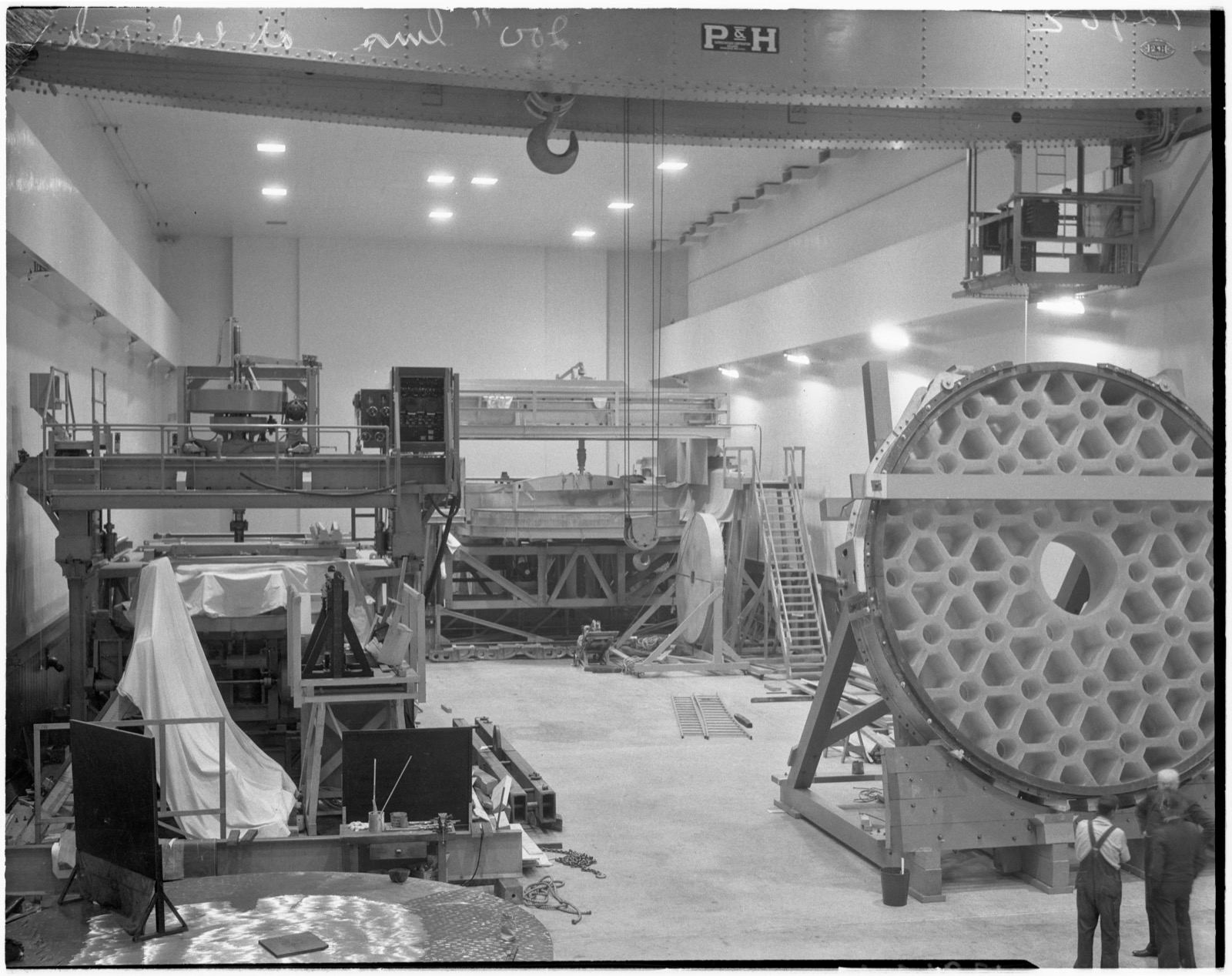
The 200-inch disc was cast by Corning in 1934, from Pyrex, after an earlier attempt in fused quartz failed and a first Pyrex pour cracked. The blank then cooled for eight months, travelled across the country by rail at restricted speed, and was ground for over a decade — interrupted by the Second World War, during which the optical shop turned to military work.
The finished mirror weighs 13 tonnes and is carried in a telescope of 481 tonnes. It was dedicated in June 1948, and Edwin Hubble took the first official photographs with it in January 1949.
The scale of that effort is the point. A telescope this size was, at the time, one of the largest precision objects ever attempted, and its twenty-year gestation is why the record stood so long. Nobody could simply build a bigger one.
Still working, and you can visit
The Hale is not a monument. It observes, with modern instrumentation and adaptive optics that its designers could not have imagined, and it does useful work on a mountain within a few hours' drive of Los Angeles.
It is also, unusually for the telescopes on this page, somewhere you can go. Palomar has a visitor gallery from which the instrument is visible — an ordinary member of the public can stand and look at the telescope that defined the limit of the observable universe for two generations.
That accessibility is why the Hale sits at the boundary of this collection. The other instruments here are things you read about. This one you can drive to.