Very Large Telescope
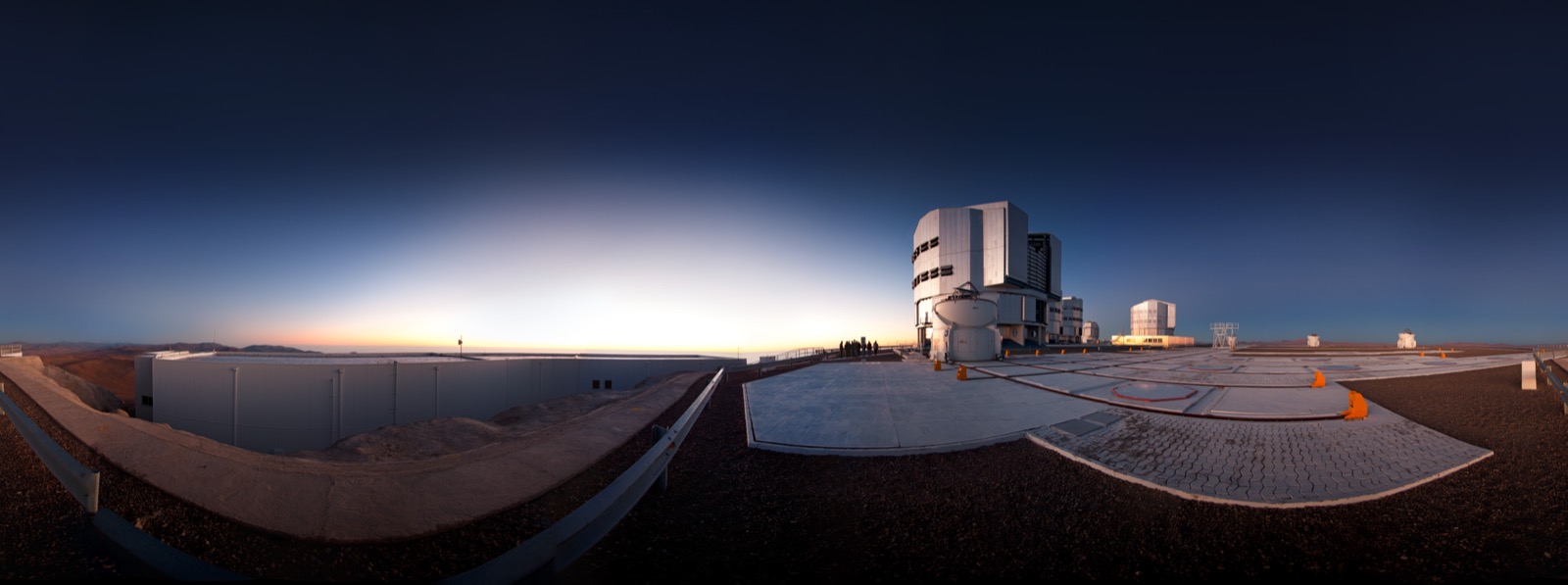
Four 8.2-metre telescopes on a Chilean ridge that can observe separately, or combine their light into one instrument no single mirror could be.
What these numbers mean
This number describes ONE of the four telescopes, not the array. Forty times an 8-inch Dobsonian across, and about 1,600 times its light grasp. When all four combine, the light-collecting power is equivalent to a single 16 m mirror — but the resolution behaves as though the mirror were as wide as the distance between them.
In interferometry, fine detail is set by the separation between telescopes rather than by their size. Spread across 140 m of ridge, the VLT resolves detail as a 140 m telescope would — while collecting only as much light as its four mirrors actually gather. Resolution and light grasp come apart, which is the idea worth taking away.
The instrument
- Aperture
- 8200
- Optical design
- Ritchey-Chrétien, four Unit Telescopes (Antu, Kueyen, Melipal, Yepun)
- Mount
- Altazimuth
The observatory
- First light
- 1998-05-25
- Status
- Operational
- Operator
- European Southern Observatory
- Site
- Cerro Paranal, Atacama Desert, Chile
- Altitude
- 2635
- Wavelength range
- Near ultraviolet to 25 µm (mid-infrared)
- Instruments
- Four 8.2 m Unit Telescopes plus four 1.8 m Auxiliary Telescopes; VLTI baselines to 140 m
Against your telescope
Aperture is aperture. The same measurement that describes this instrument describes the telescope in your garage — which is the only honest way to feel the difference.
Four telescopes, one instrument
The VLT is usually pictured as one telescope. It is four, each with an 8.2-metre mirror, named Antu, Kueyen, Melipal and Yepun — Mapuche words for the Sun, Moon, Southern Cross and Venus. They saw first light one at a time between 1998 and 2000.
Most nights they work independently, which is simply a practical way to get four large telescopes' worth of observing done. The interesting mode is the other one. Light from separate telescopes can be brought together underground, along paths whose lengths are controlled to within a fraction of a micrometre, and made to interfere.
When that works, the array resolves detail according to the distance between the telescopes rather than the width of any one mirror — up to 140 metres apart. It does not collect any more light by doing so. It simply sees finer structure in the light it has.
The engineering cost of this is easy to understand and hard to overstate: the light paths must be held stable while the Earth turns, to a tolerance far smaller than the thickness of a hair.
Why Paranal
The Atacama is the driest non-polar desert on Earth, and the VLT sits on a ridge at 2,635 metres in the middle of it. Both facts are engineering decisions rather than scenery.
Water vapour absorbs infrared light. A site with very little of it overhead can observe wavelengths that are simply unavailable from a wetter mountain, and the VLT's useful range extends from the near ultraviolet out to 25 micrometres in the mid-infrared. Altitude removes air; dryness removes the part of the air that matters most.
Darkness is the third input. There is very little around Paranal to produce light, and ESO has worked to keep it that way. A telescope this size can be built anywhere with a road; the reason it is here is that the sky above it is about as close to nothing as the surface of the planet offers.