Atacama Large Millimeter/submillimeter Array
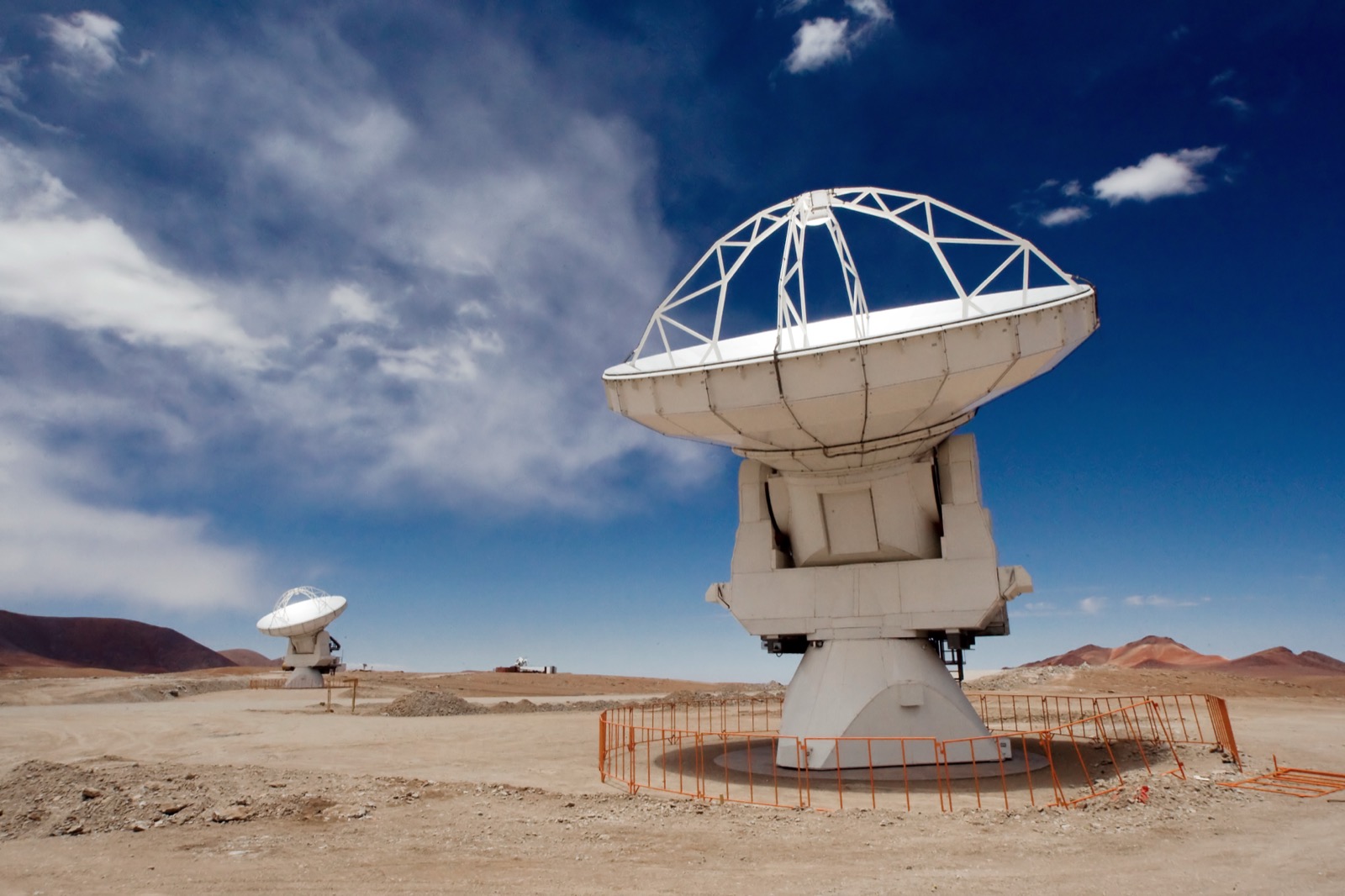
Sixty-six antennas on a plateau five kilometres above sea level, which together resolve detail as a single dish sixteen kilometres wide would.
What these numbers mean
This entry has no aperture figure, and that omission is the reason it is here. ALMA's resolution comes from the distance between its antennas — up to 16 km — not from the size of any dish. Its light-gathering power is the summed area of 66 antennas; its sharpness is a separate number entirely. Everywhere else on this site those two things travel together in one figure. Here they come apart.
High enough that staff work on oxygen and the site is approached from a lower base camp. Millimetre-wave astronomy is defeated by atmospheric water vapour, and there is almost nowhere on the planet drier or higher that you can also drive a 100-tonne antenna transporter to.
The instrument
- Optical design
- Interferometric array — 54 antennas of 12 m and 12 of 7 m
- Mount
- Altazimuth, on transporters
The observatory
- First light
- March 2013
- Status
- Operational
- Operator
- ESO / NRAO / NAOJ
- Site
- Chajnantor plateau, Atacama Desert, Chile
- Altitude
- 5000
- Maximum baseline
- 16000
- Wavelength range
- Millimetre and submillimetre
- Instruments
- 66 antennas, movable across the plateau by custom transporters
Resolution without a mirror
An ordinary telescope's sharpness is set by its aperture: the wider the mirror, the finer the detail. An interferometer breaks that rule by combining signals from separated antennas and measuring how their waves interfere. The detail it resolves is governed by the separation, not by the dishes.
ALMA's 66 antennas can be spread across 16 kilometres of the Chajnantor plateau, and are physically moved between configurations by two custom transporters. Compact arrangements are sensitive to large faint structures; spread-out ones resolve fine detail. The array is reconfigured through the year, so the telescope's characteristics are something operators choose rather than something the hardware fixes.
What it does not gain is light. Sixty-six antennas collect exactly as much as their combined area, which is why an interferometer can produce an extraordinarily sharp image of something that is nonetheless bright enough to detect. Resolution and sensitivity are separate purchases.
Why it breaks this collection on purpose
Every other entry on these pages can be placed on a single line, ordered by how wide its mirror is. That line is a useful thing: it puts a garden telescope and the ELT into one honest comparison, and it makes the scale of the largest instruments legible.
ALMA does not fit on it, and neither does Arecibo. One is an array whose resolution is a distance rather than a diameter; the other collected radio waves where the whole relationship between aperture and detail is different. Placing them on that line would produce a number that is arithmetically fine and physically meaningless.
That is worth ending on. Aperture is the most useful single number in amateur astronomy, and it stays useful all the way up to a 39-metre mirror. But it is a convention that suits one kind of instrument, and the moment you leave visible light or a single focus, it stops describing what the telescope actually does.