Arecibo Observatory
A 305-metre dish built into a Puerto Rican sinkhole that could not point at anything — and, for fifty-seven years, heard more than anything else on Earth.
What these numbers mean
Fifteen hundred times the diameter of an 8-inch Dobsonian, which sounds absurd until you notice it collected radio waves rather than light. Radio wavelengths are centimetres where visible light is a fraction of a micrometre, so a radio telescope needs an enormous dish to achieve resolution an amateur refractor manages at 60 mm. The number is real; comparing it to an optical aperture is not.
The instrument
- Aperture
- 305000
- Optical design
- Fixed spherical reflector with a steerable suspended feed platform
- Mount
- None — the dish was fixed; the receiver moved
The observatory
- First light
- 1963
- Status
- Collapsed 1 December 2020
- Operator
- US National Science Foundation
- Site
- Arecibo, Puerto Rico
- Wavelength range
- Radio
- Instruments
- Radio receivers and a planetary radar transmitter
Against your telescope
Aperture is aperture. The same measurement that describes this instrument describes the telescope in your garage — which is the only honest way to feel the difference.
The telescope that could not point
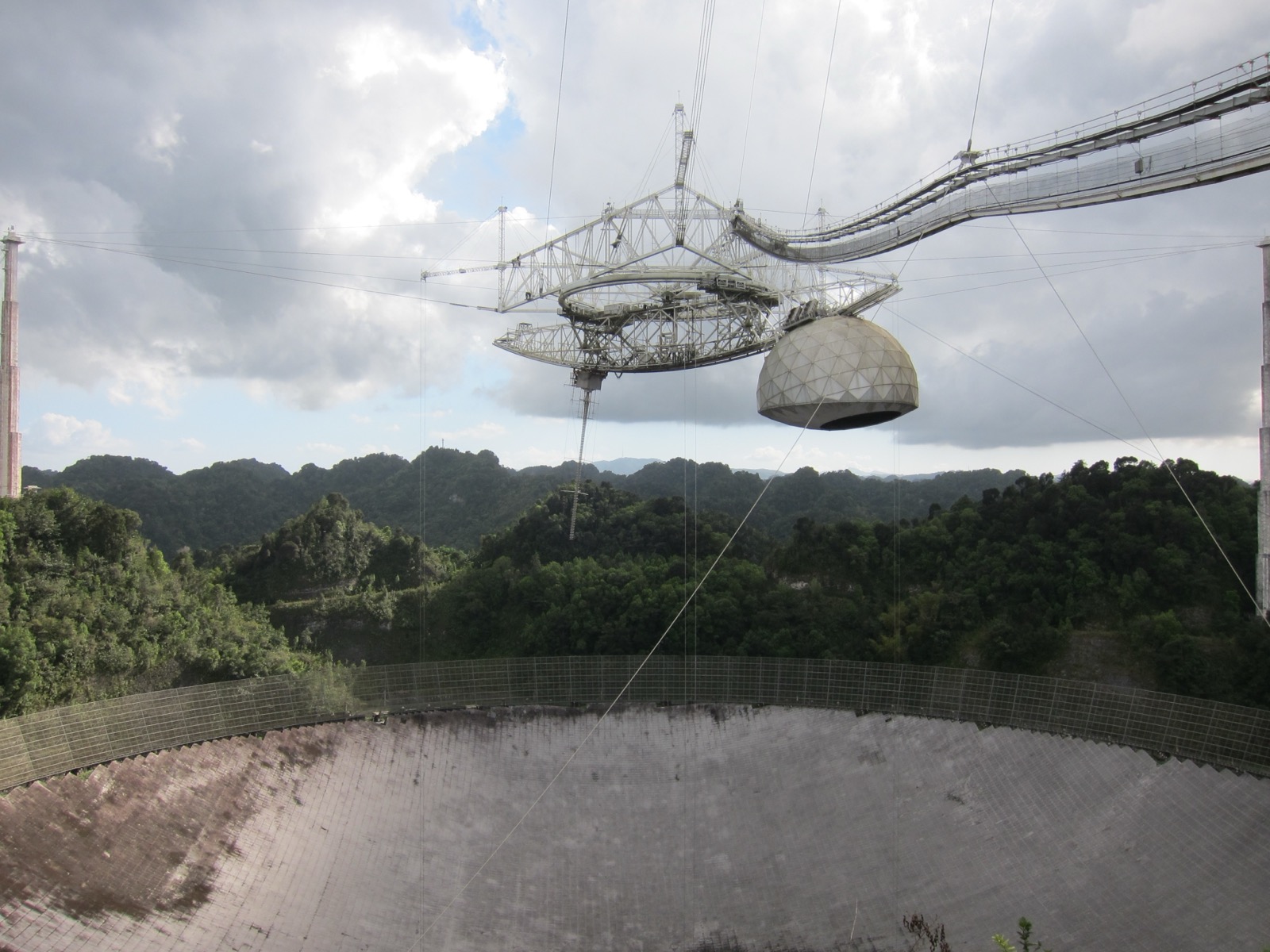
Almost every telescope moves. Arecibo did not. Its reflector was a fixed 305-metre spherical bowl fitted into a natural sinkhole in the Puerto Rican karst, and it stayed exactly where it was for the whole of its life.
What moved was the receiver. A 900-tonne platform hung on cables from three concrete towers above the dish, and steering it across that suspended arc pointed the telescope — within about twenty degrees of overhead. Everything else, Arecibo simply waited for the Earth to bring past.
The spherical shape is the reason this works at all. A parabola has one focus and must be aimed; a sphere is the same shape seen from every direction, so a feed moved above it can select a different patch of sky without the bowl moving. The cost is spherical aberration, corrected by the shaped feed structure.
It also transmitted. Arecibo carried a planetary radar powerful enough to bounce signals off asteroids and read the echo — one of very few instruments that did not merely listen.
1 December 2020
In August 2020 a cable pulled out of its socket and tore a gash in the dish. In November a main cable snapped. On 1 December, at about 7:55 in the morning, the remaining cables gave way and the 900-tonne platform fell into the bowl below.
The investigation found the cause to be zinc creep in the cable sockets — the zinc that anchored the cables had slowly flowed under long-term load, letting the wires pull free. The National Academies' report noted that this kind of failure had never been reported previously in over a century of widespread zinc spelter socket use. The structure was not neglected and did not fail in a way anyone had been watching for. It failed in a way nobody had seen before.
Arecibo is on this page because a collection of great telescopes that includes only the working ones is a collection that has quietly edited out the risk. Instruments of this scale are singular objects, built once, and when they end they are not replaced. Fifty-seven years of observations exist because it was built; nothing has taken its place.