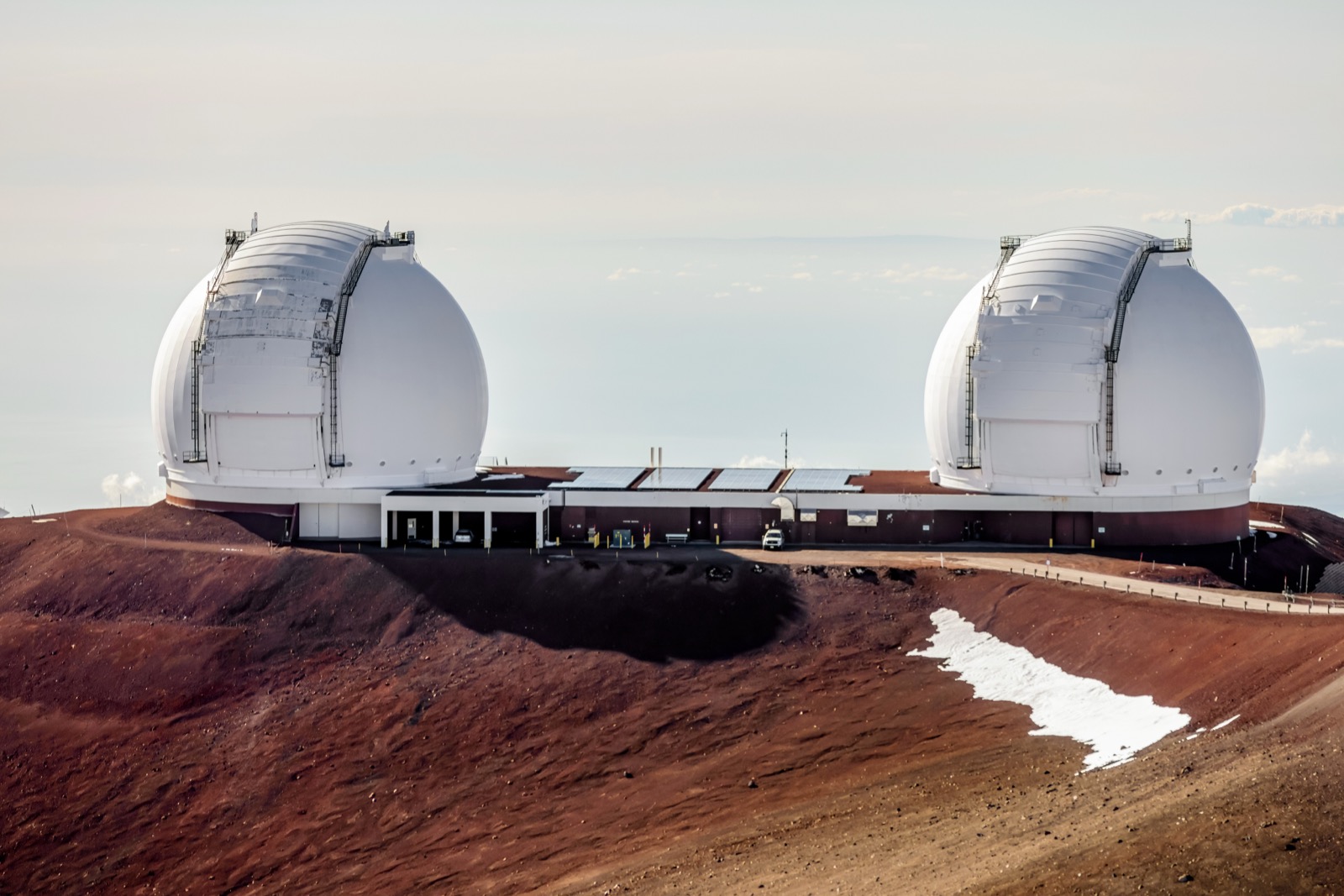
W. M. Keck Observatory
Two ten-metre telescopes whose mirrors are not mirrors at all, but thirty-six hexagons each, held in formation to a fraction of a wavelength.
What these numbers mean
Forty-nine times the diameter of an 8-inch Dobsonian, and about 2,400 times its light-gathering area. But no single piece of glass in it is larger than 1.8 m — roughly a large amateur mirror. The size is an arrangement, not a casting.
High enough that the air holds around forty percent less mass above you than at sea level, and most of the water vapour is below. Site altitude is not a luxury for a telescope this size; it is part of the optical design.
The instrument
- Aperture
- 10000
- Optical design
- Segmented Ritchey-Chrétien (36 hexagonal segments, 1.8 m each)
- Mount
- Altazimuth
- Mass
- 245000
The observatory
- First light
- 1990-11-24
- Status
- Operational
- Operator
- Caltech / University of California / NASA
- Site
- Maunakea, Hawaiʻi
- Altitude
- 4145
- Instruments
- Two 10 m telescopes, Keck I and Keck II, with laser guide star adaptive optics
Against your telescope
Aperture is aperture. The same measurement that describes this instrument describes the telescope in your garage — which is the only honest way to feel the difference.
Why the mirror is in pieces
There is a hard limit to casting telescope mirrors. Glass sags under its own weight, and the thicker you make it to resist sagging, the heavier it gets and the more it sags. Past about eight metres the problem stops being difficult and starts being structural.
Keck's answer was to stop trying. Each 10-metre primary is 36 hexagonal segments, each 1.8 metres across — a size that was already routine to make. The segments are held in a honeycomb and actively pushed and pulled, twice a second, to keep the whole surface behaving as one continuous curve.
The tolerance is the striking part. The segments must stay aligned to a few nanometres relative to each other. If a segment drifts, the telescope stops being a 10-metre mirror and becomes 36 small ones pointing in slightly different directions.
Every giant telescope built since has used this idea. The ELT's 39-metre mirror is 798 segments. Keck is the reason that sentence is possible.
Beating the air you are sitting under
A ground telescope has a disadvantage no space telescope shares: about a hundred kilometres of moving atmosphere between it and everything it wants to look at. Air cells of different temperature bend light continuously, which is why stars twinkle and why, for most of the twentieth century, a very large ground telescope could not resolve much more detail than a modest one.
Adaptive optics removed that ceiling. A deformable mirror measures the incoming distortion and cancels it by changing shape hundreds of times a second. Where there is no bright star nearby to measure against, a laser is fired into the upper atmosphere to make one.
The result is that a 10-metre telescope on the ground can, in the infrared, resolve finer detail than Hubble. This is the fact that most surprises people: the atmosphere is a solvable problem, and once solved, aperture wins. It is also why the largest telescopes are built on mountains rather than launched.