Hubble Space Telescope
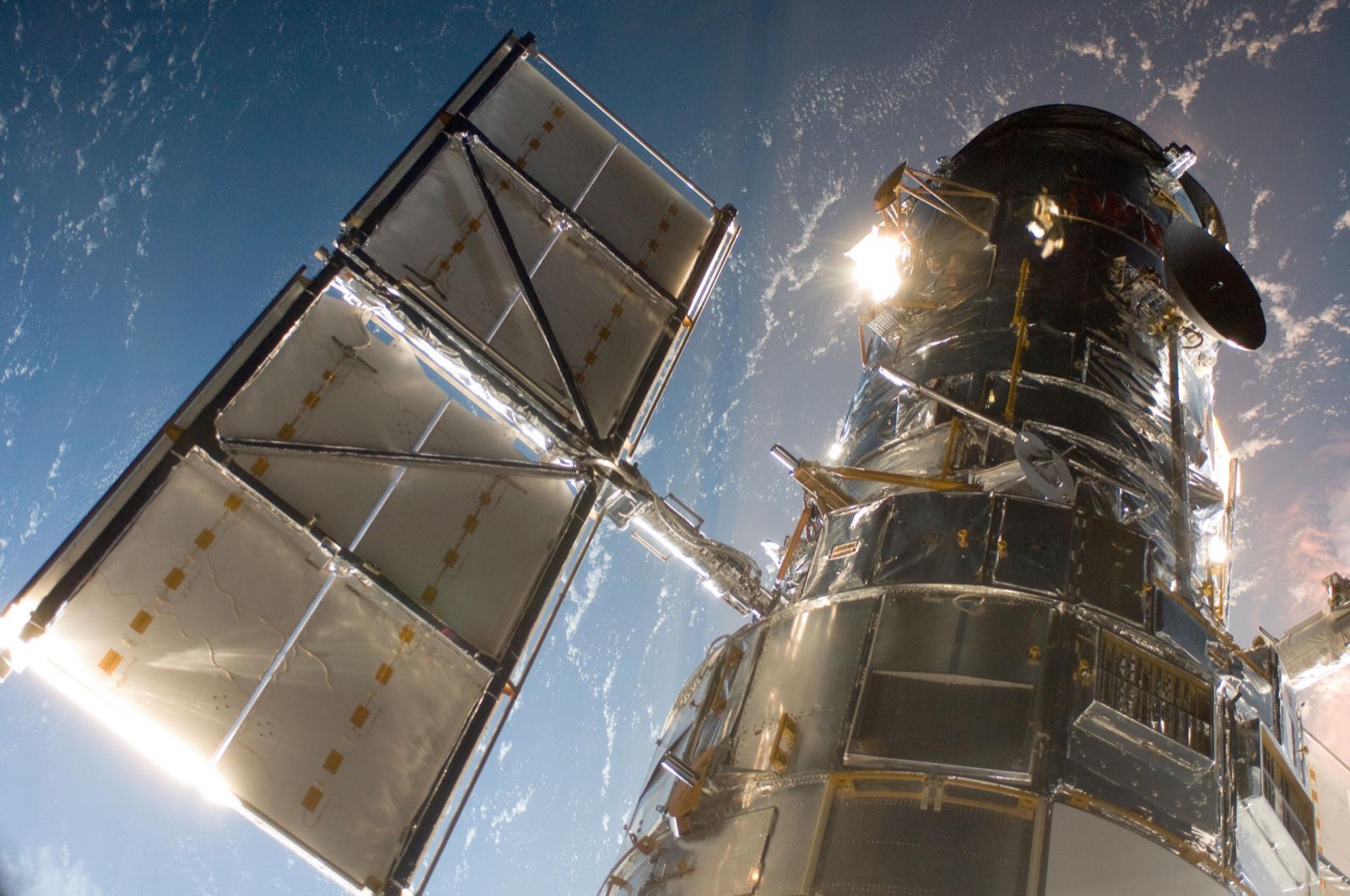
A 2.4-metre mirror parked above the atmosphere in 1990, launched with a flawed figure, repaired by hand, and still returning science more than three decades later.
What these numbers mean
Just under twelve times the diameter of a common 8-inch Dobsonian, which works out to roughly 140 times the light-gathering area. That is a large telescope but not an extraordinary one — plenty of amateur observatories have mirrors half this size. What Hubble bought was not aperture. It was the removal of the atmosphere, and with it the seeing limit that caps every ground-based telescope at somewhere around one arcsecond on a good night.
Very slow by backyard standards, where f/5 to f/10 is normal. A slow beam spreads the image over a lot of focal plane, which is what you want when your detectors are small and your priority is resolving fine detail rather than framing wide fields. The cost is field of view: Hubble sees a very small piece of sky at a time, which is exactly the trade Roman was later built to reverse.
This is the figure NASA itself publishes for the whole mission since its official start in 1977, adjusted to 2021 dollars, and it excludes the shuttle flights that deployed and serviced the telescope. Early program estimates were in the hundreds of millions. Both numbers get quoted as 'the cost of Hubble', which is why this page states the basis rather than a bare figure.
The instrument
- Aperture
- 2400
- Focal length
- 57600
- Focal ratio
- f/24
- Optical design
- Ritchey-Chrétien Cassegrain
- Mount / orbit
- None (low Earth orbit)
- Mass
- 12200
The mission
- Launched
- 1990-04-24
- Status
- Operational
- Operator
- NASA / ESA
- Orbit
- Low Earth orbit, about 483 km, inclined 28.5°
- Wavelength range
- 115–2500 nm (ultraviolet / visible / near-infrared)
- Instruments
- WFC3, ACS, COS, STIS, FGS
Against your telescope
Aperture is aperture. The same measurement that describes this instrument describes the telescope in your garage — which is the only honest way to feel the difference.
The flaw that almost ended it
Hubble launched on 24 April 1990 aboard the shuttle Discovery. Within weeks it was clear something was wrong with the images. Stars did not come to a clean point; they sat inside a faint halo, and the sharpness the telescope had been built to deliver was simply not there.
The cause was spherical aberration in the primary mirror: it had been ground too flat away from its centre, so light from the edge and light from the middle came to focus in different places. NASA describes the size of the error as less than one millionth of a metre — a mere fiftieth of the width of a human hair. It is worth sitting with how small that is. The mirror was one of the most precisely figured optical surfaces ever made, and it was wrong by an amount you could not see, feel, or measure without an interferometer. It was also wrong by ten times the tolerance the design required, because at these wavelengths that tolerance is a fraction of a wavelength of light.
The cause of the cause is the part worth remembering. ESA attributes the aberration to the malfunction of a measuring device used while the mirror was being polished, and NASA gives the concrete figure: a spacing was off by 1.3 millimetres. So a millimetre-scale error in the equipment that checked the work produced a sub-micron error in the work itself, and the mirror was signed off as correct.
The error was consistent, which turned out to be the saving grace. A random defect cannot be compensated; a known, repeatable aberration can be cancelled by an equal and opposite one. In December 1993 the first servicing mission installed two answers. WFPC2, a replacement camera, carried the correction built into its own optics. COSTAR, which was not a science instrument at all but a set of movable mirrors on an arm, put corrective optics into the light path feeding the remaining instruments. The astronauts effectively fitted the telescope with spectacles.
After that, Hubble worked as designed. Every instrument installed since has carried its own correction internally, and COSTAR was eventually removed as unnecessary.
Why it is still working
The reason Hubble could be repaired at all is that someone decided, early, to put it somewhere a crew could reach. It orbits roughly 483 km up, in low Earth orbit, inclined 28.5° to the equator — well within shuttle range. That single choice is why a mirror error discovered after launch became a maintenance problem rather than the end of the mission.
Five servicing missions followed. They did not merely fix things; they repeatedly replaced the science instruments with better ones. The telescope flying today carries WFC3, ACS, COS, STIS and the Fine Guidance Sensors, none of which were aboard at launch in their current form. The mirror is from the 1970s. Almost nothing looking through it is.
The shuttle is retired and there is no plan to service Hubble again, which makes what it covers unusually important. Hubble works from 115 nanometres in the ultraviolet out to 2500 nanometres in the near-infrared. Webb, its notional successor, starts at 600 nanometres and goes the other way, into the mid-infrared. The overlap is narrow and the ultraviolet is not covered at all. Earth's atmosphere blocks ultraviolet light completely, so no ground telescope can take up the slack either.
When Hubble stops, a whole band of the spectrum goes dark for astronomy, with no instrument built or funded to replace it. That is a more useful way to think about the telescope's importance than any single image it has returned.
Watch
Where these numbers come from
- NASA — Hubble optics: 2.4 m primary, Ritchey-Chrétien, primary mirror 828 kg; and on the flaw, "The curvature of the mirror was off by less than one millionth of a meter — or a mere 1/50th the width of a human hair."
- NASA — Hubble by the Numbers: mass "27,000 pounds (12,200 kg)". Note this page prints the focal length as "189 feet (56.7 m)"; 189 feet is 57.6 m, and 57,600 mm is what f/24 on a 2400 mm aperture gives — see the STScI Primer below.
- NASA — About Hubble (orbit 483 km; 115–2500 nm; instruments)
- STScI — HST Primer, Table 3.1: design Ritchey-Chrétien Cassegrain, aperture 2.4 m, focal ratio f/24
- NASA — Hubble's Mirror Flaw: "The spacing was off by 1.3 millimeters, which resulted in a mirror that was too flat away from its center"; "The error was 10 times larger than the specified tolerance"
- ESA/Hubble — the spherical aberration problem: caused by "the malfunction of a measuring device used during the polishing of the mirror"
- NASA — Servicing Mission 1, December 1993 (COSTAR and WFPC2)
- NASA — Hubble FAQs: mission cost approximately $16 billion in 2021 dollars since 1977
- NASA History — early Hubble cost estimates (hundreds of millions)