Chandra X-ray Observatory
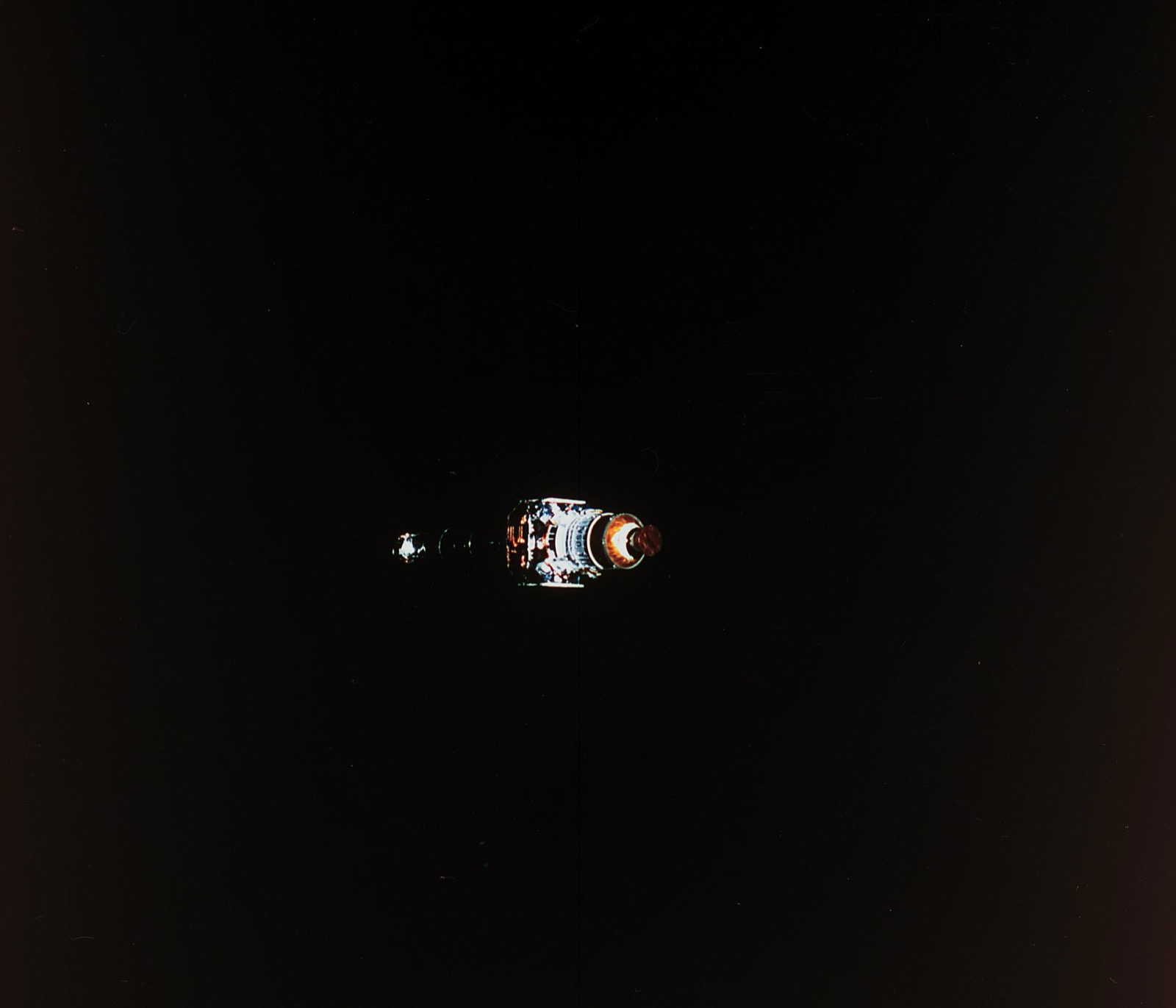
An X-ray telescope whose mirrors do not face the sky at all — light skims across them at a grazing angle, which is why the two numbers you would normally ask for do not exist.
What these numbers mean
This is the honest substitute for an aperture figure, and notice that it is not one number. The Chandra Proposers' Observatory Guide tabulates the mirror assembly at 800 cm² at 0.25 keV, 400 cm² at 5 keV and 100 cm² at 8 keV, because how much of the surface reflects at all depends on the photon's energy as well as the grazing angle. A 60 mm refractor has a fixed geometric aperture of about 28 cm² whatever you point it at. Chandra collects roughly 28 times that at the soft end of its band and about 3.5 times that at the hard end — the same instrument, varying eight-fold across its own range. An aperture figure cannot express that, which is one more reason this page does not print one.
Ten metres — 10.070 metres to the tolerance the Observatory Guide quotes — which is why the spacecraft is 45 feet long: the mirrors sit at one end and the detectors at the other, with nothing much in between. A backyard telescope achieves a long focal length by folding the light path back on itself with a secondary mirror. Grazing-incidence optics cannot do that — every extra reflection costs you photons you cannot spare — so the focal length has to be spent as physical length.
About the same as what a very large ground telescope achieves on an exceptional night, and roughly ten times better than any X-ray telescope that came before it. The comparison that matters is not with optical instruments, though — it is with the blur circles earlier X-ray missions produced, which were measured in arcminutes.
The instrument
- Focal length
- 10000
- Optical design
- Wolter Type I grazing incidence — four nested pairs of paraboloid / hyperboloid mirrors
- Mount / orbit
- None (high elliptical Earth orbit)
- Mass
- 4800
The mission
- Launched
- 1999-07-23
- Status
- Operational
- Operator
- NASA (Marshall Space Flight Center; operated by the Chandra X-ray Center at the Smithsonian Astrophysical Observatory)
- Orbit
- High elliptical Earth orbit, 10,000 × 140,161 km, inclined 28.5°
- Wavelength range
- 0.09–10 keV (X-ray)
- Instruments
- ACIS, HRC, HETG, LETG
The telescope with no aperture
This page deliberately does not list an aperture or a focal ratio for Chandra. That is not an oversight and it is not missing data. Those two numbers describe a filled circular opening that collects light arriving head-on, and Chandra does not have one.
X-ray photons carry enough energy that they do not bounce off a mirror the way visible light does. Hit a polished surface at anything close to perpendicular and the photon is absorbed — it goes into the material rather than off it. The only way to steer X-rays is to bring them in at a very shallow angle, a few degrees or less, so they skip off the surface the way a flat stone skips off water. This is called grazing incidence.
So Chandra's optics are not dishes. They are barrels. Four nested pairs of mirrors, each pair a paraboloid section followed by a hyperboloid section, each 83.3 cm long, arranged as concentric cylinders that the X-rays enter almost edge-on and glance along twice before converging ten metres downstream. This arrangement has a name — Wolter Type I — and it is the standard form for a focusing X-ray telescope. The four barrels have outer diameters of 1.23, 0.99, 0.87 and 0.65 metres. The largest of those is the closest thing to an aperture figure Chandra has, but the light-collecting part is only the thin ring of surface actually presented at a grazing angle. The middle is empty, and so is most of the circle.
That is why the useful number is effective area rather than aperture, and why even that is not a single figure: the Observatory Guide gives 800 square centimetres at 0.25 keV, 400 at 5 keV and 100 at 8 keV, because reflectivity depends on photon energy as well as grazing angle. An f-ratio is meaningless here for the simpler reason that there is no diameter to divide the focal length by. The mirrors are coated in iridium and remain among the smoothest surfaces ever manufactured, because at a grazing angle a surface imperfection that would be invisible in a visible-light mirror scatters the photon away entirely.
What the X-ray sky looks like
Nothing warm shows up in Chandra's images. The visible sky is dominated by stars, which are thousands of degrees. The X-ray sky is dominated by material at millions of degrees, and there is no overlap — a scene that is bright in one is usually blank in the other.
What produces X-rays is gas that has been violently heated: matter falling towards a black hole and shredding itself on the way in, the shock front of a supernova ploughing into the surrounding interstellar medium, the hot plasma that fills the space between galaxies in a cluster and outweighs all the galaxies in it. Point an optical telescope at a galaxy cluster and you see galaxies with darkness between them. Point Chandra at the same cluster and the space between them lights up, because that is where most of the ordinary matter actually is.
Chandra covers 0.09 to 10 keV across its instruments — ACIS and the High Resolution Camera for imaging, the high- and low-energy transmission gratings for spectra. None of this reaches the ground. Earth's atmosphere absorbs X-rays completely, which is why X-ray astronomy did not exist until rockets could get above it and why every observation Chandra has ever made had to be made from orbit.
Its orbit is unusual too: an ellipse running from about 10,000 km out to roughly 140,000 km, more than a third of the way to the Moon, taking 64 hours to complete. That takes the observatory clear of Earth's radiation belts for the great majority of each orbit, which is what allows long, uninterrupted exposures on faint sources.
Watch
Where these numbers come from
- Chandra X-ray Center — specifications: 4 nested grazing-incidence paraboloid/hyperboloid mirror pairs, focal length 10 m, outer diameter 1.2 m, iridium coating, observatory weight 4,800 kg, orbit 10,000 × 140,161 km at 28.5°
- Chandra Proposers' Observatory Guide, ch. 4 (HRMA) — "Wolter Type-I mirrors"; focal length 10.070 ± 0.003 m; mirror outer diameters 1.23, 0.99, 0.87, 0.65 m; effective area 800 cm² at 0.25 keV, 400 cm² at 5.0 keV, 100 cm² at 8.0 keV; "the HRMA throughput varies with X-ray energy"
- Chandra X-ray Center — specifications litho: mirror segments 83.3 cm long, 0.5 arcsec resolution, ACIS 0.2–10 keV, HETG 0.4–10 keV, LETG 0.09–3 keV, orbital period 64 hours
- Chandra X-ray Center — the mission: launched by Space Shuttle Columbia on 23 July 1999; managed by NASA Marshall, operated by the CXC at SAO
- Chandra X-ray Center — the telescope system (four mirror pairs, iridium, alignment)
- Chandra X-ray Center — mission cost breakdown: $1,586M pre-Phase A through development plus calibration facility, in real-year dollars
- MSFC fact sheet — Chandra quick facts (orbital period 64 hours, apogee, instruments)