Nancy Grace Roman Space Telescope
The same 2.4-metre mirror size as Hubble, arranged to see a hundred times more sky at once — a survey machine rather than a portrait lens.
What these numbers mean
Identical to Hubble's, and about twelve times the diameter of a common 8-inch Dobsonian. Roman's mirror weighs 186 kg against Hubble's 828 kg for the same 2.4 metres, which is thirty years of mirror-making showing up as mass rather than as size. Anyone who has lifted an 8-inch mirror out of its cell will recognise what a four-fold weight saving at the same diameter is worth.
This is the single number that separates Roman from Hubble. Same mirror diameter, but f/7.9 instead of f/24 — a focal length roughly three times shorter, which spreads far less magnification across the same detector area and therefore covers far more sky per exposure. It is exactly the trade you make at home when you choose a fast f/5 imaging newtonian over a slow f/10 SCT: you give up image scale and you buy field.
Roman's Wide Field Instrument sees a view around a hundred times larger than Hubble's comparable camera at similar sharpness. In its first five years it is expected to survey roughly fifty times as much sky as Hubble covered in thirty. Depth is not what changed. Throughput is.
The instrument
- Aperture
- 2400
- Focal ratio
- f/7.9
- Optical design
- Three-mirror anastigmat
- Mount / orbit
- None (Sun–Earth L2 halo orbit)
The mission
- Launched
- 2026-08-30
- Status
- Not yet operational
- Operator
- NASA
- Orbit
- Sun–Earth L2, about 1.5 million km from Earth
- Wavelength range
- 0.48–2.30 µm (visible / near-infrared, Wide Field Instrument)
- Instruments
- Wide Field Instrument, Coronagraph Instrument
Against your telescope
Aperture is aperture. The same measurement that describes this instrument describes the telescope in your garage — which is the only honest way to feel the difference.
Hubble's mirror, a hundred times the field
Roman and Hubble have the same size primary mirror: 2.4 metres, 7.9 feet. Almost nothing else about the two optical systems is the same, and the comparison is the clearest illustration you will find of what optical design actually buys you once aperture is fixed.
Hubble is a Ritchey-Chrétien Cassegrain — two hyperbolic mirrors, an f/24 beam, a 57.6-metre focal length. Roman is a three-mirror anastigmat: three curved mirrors instead of two, an f/7.9 beam, and a focal length roughly three times shorter. The extra mirror is what makes the short focal length usable. Two-mirror designs go soft off-axis; adding a third surface gives the designer enough freedom to hold the image sharp across a field many times wider than a Cassegrain of the same aperture could manage.
The payoff is that Roman's Wide Field Instrument sees about a hundred times more sky per exposure than Hubble's equivalent camera, at broadly comparable sharpness. This is the same trade any imager makes when choosing between a fast, wide astrograph and a long, slow planetary instrument, scaled up by a factor of a few thousand in budget.
The mirror itself carries a second lesson. Hubble's 2.4-metre primary weighs 828 kg. Roman's weighs 186 kg — less than a quarter, at identical diameter. It is not lighter because anyone wanted a lighter telescope; it is lighter because thirty years of materials and fabrication work made the same optical surface cheaper to lift.
What a wide field buys you
There are two ways to make a telescope more productive. You can make it see fainter, which means more aperture, or you can make it see more at once, which means more field. Since the 1990s the first route has been getting steadily more expensive and the second has been getting cheaper, mostly because detectors got large and affordable while big mirrors did not.
Roman is built almost entirely around the second route. Its core surveys are area-driven: a high-latitude wide-area survey covering about 5,100 square degrees, roughly 12% of the sky, and a galactic plane survey that expects to map up to twenty billion stars. Neither of those is a question you can answer by staring longer at one spot. They are questions about how many, and about how the answer varies across the sky, and those need coverage.
The science follows from that shape. Weak gravitational lensing works by measuring the slight distortion of a very large number of galaxy shapes, so it wants millions of galaxies rather than a deep look at a few. Microlensing planet detection needs to monitor an enormous number of stars continuously, because any individual alignment is rare and unpredictable. Neither technique is limited by how faint you can go. Both are limited by how many objects you can hold in the frame at once.
Roman is designed to operate from Sun–Earth L2, the same neighbourhood as Webb, which gives it a stable thermal environment and an unobstructed view. It is built for a five-year prime mission with a ten-year goal, and unusually it is designed to be refuellable, even though no vehicle currently exists that could go and do it.
Watch
Where these numbers come from
- NASA — Roman observatory technical overview: primary mirror 2.4 m (2.36 m effective aperture stop), f/7.9 converging beam for the WFI, Sun–Earth L2, five-year prime mission with ten-year goal
- NASA — Hubble vs. Roman: both 2.4 m; Hubble is a Ritchey-Chrétien Cassegrain and Roman a three-mirror anastigmat; Roman's focal length is roughly three times shorter; WFI field of view about 100× Hubble's; Roman 0.48–2.30 µm
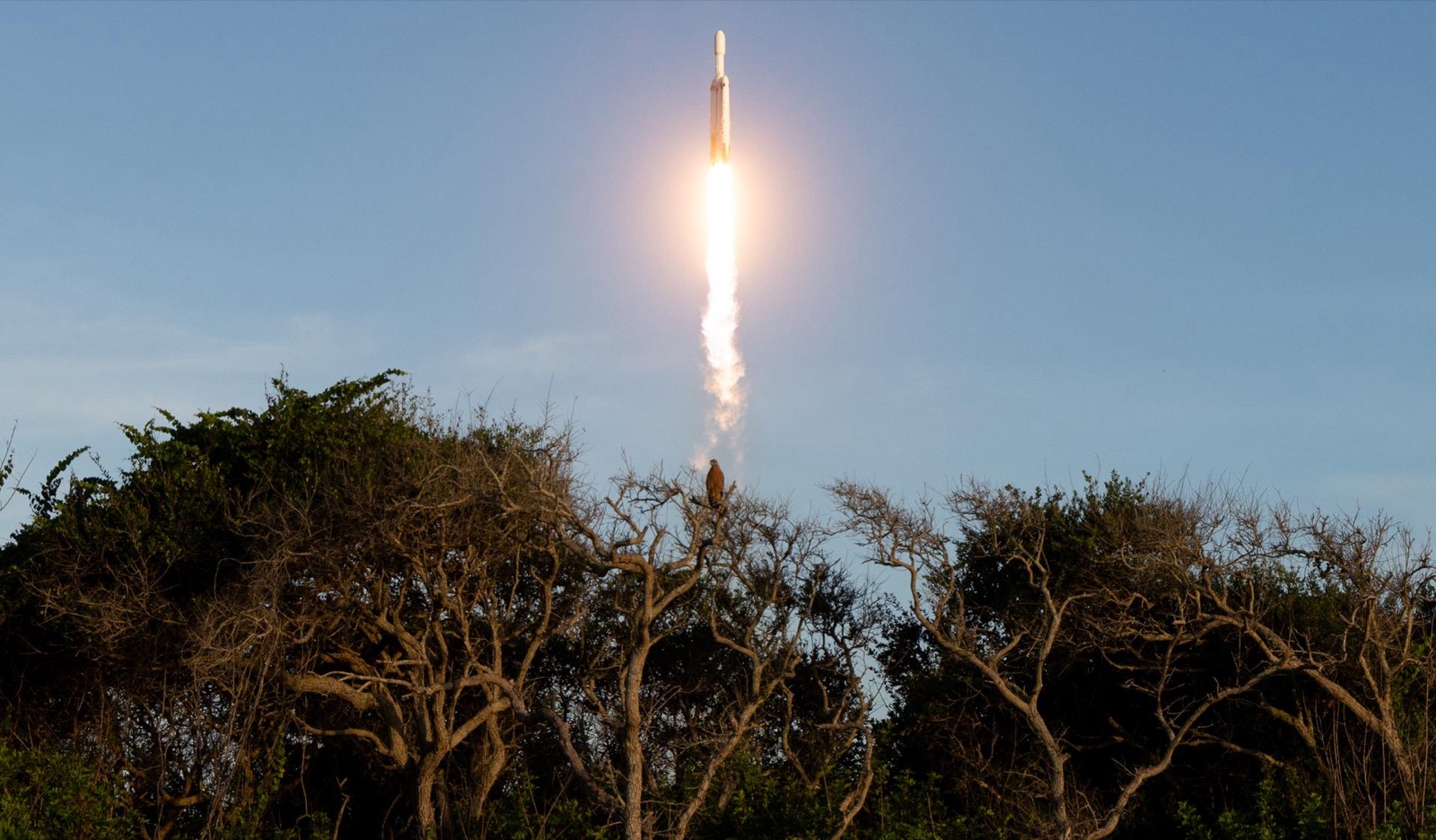
- NASA — Roman mission page: launch on a SpaceX Falcon Heavy from Launch Complex 39A, Kennedy Space Center. Check it for current commissioning status.
- NASA — "NASA Concludes Roman Space Telescope Launch Coverage", 30 August 2026: Roman "successfully launched aboard a SpaceX Falcon Heavy rocket and separated from the second stage"
- NASA — Roman press kit, August 2026: primary mirror 2.4 m and 186 kg, L2 orbit, 5,100 square degree high-latitude survey, galactic plane survey of up to 20 billion stars, designed to be refuelable
- NASA — flight design milestone review: total lifecycle cost of $4.3 billion
- NASA — Hubble optics: 2.4 m primary mirror weighing 828 kg