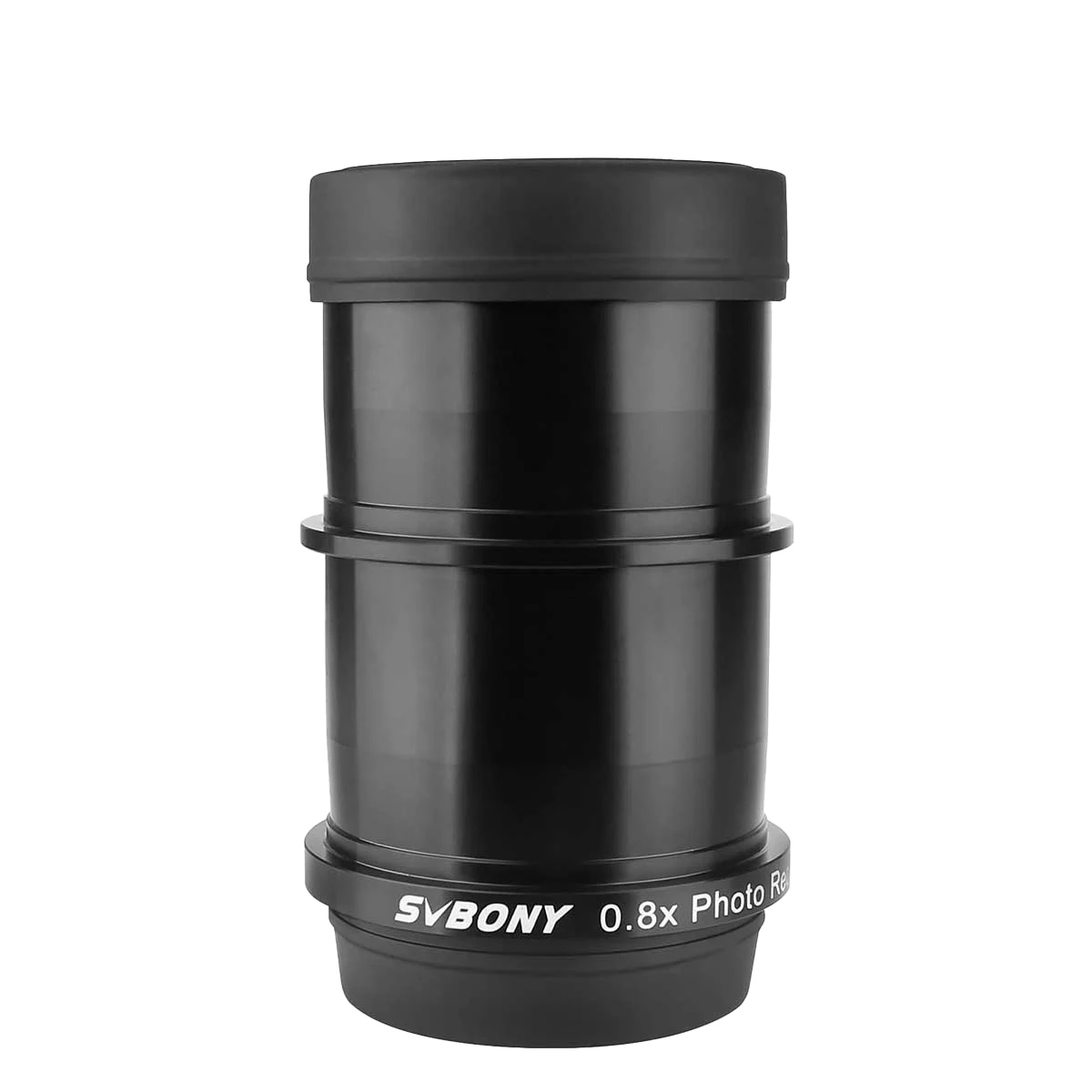
SVBony SV193 0.8x Reducer Field Flattener — image 1
SVBony

SVBony SV193 0.8x Reducer Field Flattener

0.8x reducer and field flattener · 2 inch, M48 · for the SV503 line · W9152D

Flattens the curved focal plane of an SV503 refractor and shortens its focal length by a fifth at the same time. The component those telescopes assume you will buy.

84/ 100
Polaris Score
The component that makes an SV503 an imaging telescope
From$107.99
Where to buy
Affiliate link — we earn a commission, you pay the same. We rank on fit, not payout.
What problem does this solve?

A refractor focuses onto a curved surface. Your sensor is flat.

Every simple refractor brings light to focus on a gently curved surface rather than a plane. Your eye does not notice, because it accommodates. A camera sensor is rigidly flat, so if the centre of the frame is sharp the corners are focused slightly behind it, and the stars there stretch into small radial commas. The faster the telescope and the larger the sensor, the more obvious it becomes.

A field flattener adds a small optical group near the camera that pushes the focal surface flat. This one also acts as a 0.8x reducer, shortening the telescope's focal length by a fifth and speeding it up by the same factor squared. On an SV503 102ED that turns 714 mm at f/7 into 571 mm at f/5.6, so the field gets wider and the exposures get shorter at the same time.

You need one if
You need one the first time you photograph through an SV503 and find the centre stars sharp while the corners look like small seagulls.
You can skip it if
Skip it if you only observe visually, since the eye accommodates the field curvature that a sensor cannot, or if you own a telescope with a corrector already built into the tube.
How it actually works

What the setup looks like.

A flattener only works at one exact distance from the sensor. Fitting one is mostly a spacing exercise:

A flattener only works at one exact distance from the sensor. Fitting one is mostly a spacing exercise:

1
Thread it into the focuser
The 2 inch M48 barrel goes into the focuser drawtube in place of your diagonal or nosepiece.
2
Set the spacing to the sensor
This is the step that decides whether it works. The distance from the flattener's rear thread to the sensor surface must match its design figure, and getting it wrong by a couple of millimetres reintroduces the corner distortion you bought it to remove.
3
Count everything in between
A filter drawer, an off-axis guider and the camera's own sensor depth all count toward that distance. Add them up on paper, then buy spacer rings to make up the difference.
4
Check on a star field
Take a short exposure of a rich field and look at the corners. Elongation pointing outward means too much spacing, inward means too little.

Because it is a reducer as well as a flattener it changes your image scale. Recompute your arcseconds per pixel after fitting it, since a fifth off the focal length is a real change to how the telescope samples the sky.

01Will it fit my setup

Compatibility.

What this accessory works with — check the fit before you check the price.

What this accessory works with — check the fit before you check the price.

SVBony SV503 refractors, which it is designed around2 inch focusers with an M48 threadOther f/6 to f/7 ED doublets of similar aperture, with spacing verifiedSensors up to APS-C
Note✕Designed for the SV503 line, so correction on other telescopes is not guaranteed✕Requires exact spacing to the sensor, which is fiddly the first time✕Changes focal length, so image scale and guiding requirements both shift✕Adds glass, and therefore adds a little back focus of its own
02The numbers

What These Numbers Mean

5 numbers in plain English · full specifications

5 numbers in plain English · full specifications

Reduction factorMeaningful
0.8x
Multiplying focal length by 0.8 does two things at once. The field of view grows by a quarter, and because focal ratio falls by the same factor the telescope gathers light on an extended object about 1.56 times faster. An SV503 102ED goes from 714 mm at f/7 to 571 mm at f/5.6, which is close to an hour of exposure saved for every hour and a half.
Optical designStandard
3 elements in 2 groups
Three elements is the usual count for a reducing flattener, enough to flatten the field and correct the colour error that reducing introduces. More elements would correct further and cost more light and more money. This is the arrangement almost every manufacturer settles on for a doublet refractor.
Sensor coverageSufficient
Up to APS-C
A flattener corrects a circle of a given diameter, and your sensor must fit inside it. APS-C has a 28 millimetre diagonal, which covers every 1 inch and 4/3 astronomy camera with room over. A full frame sensor would reach past the corrected circle and show soft corners again.
WeightLight
177 g
Weight at the back of a focuser matters more than weight anywhere else, because it acts on a long lever and can make a drawtube sag. At 177 grams this is light enough that a rack and pinion focuser of the kind fitted to the SV503 holds it without measurable droop.
Thread2 inch standard
M48 x 0.75
M48 is the standard 2 inch photographic thread, so this connects to the wide ecosystem of spacer rings, adapters and camera nosepieces that use it. That matters here because you will almost certainly need one or two spacer rings to land on the exact back focus figure.
Optical
Function0.8x reducer and field flattener
Elements3 elements in 2 groups
CoatingsFully multi-coated
Blackened edgesYes
Fit
Barrel2 inch
ThreadM48 x 0.75
Weight177 g
Designed forSVBony SV503 line
03Before you buy

Good to know.

The honest caveats — the things that save you a return, a bad first night, or a second purchase you didn't need.

The honest caveats — the things that save you a return, a bad first night, or a second purchase you didn't need.

Spacing is the whole job.
A flattener at the wrong distance is worse than no flattener, because it introduces its own distortion on top of the field curvature. Measure, add up every component between it and the sensor, and buy the spacer rings you need before your first clear night.
It changes your image scale.
Cutting focal length by a fifth changes arcseconds per pixel by the same proportion. That is usually welcome, since it moves an oversampled setup toward the seeing limit, but it means your guiding tolerance and your framing both change.
It is designed around the SV503.
It will physically thread onto many f/6 to f/7 doublets, and correction is only guaranteed on the telescopes it was computed for. On another brand, verify with a star field before assuming it works.
Visual observers do not need one.
The eye accommodates field curvature without noticing. This solves a photographic problem and does nothing you can see at an eyepiece.
Editor’s Take

There is a recurring pattern in budget astrophotography where the telescope is affordable and the thing that makes it work is sold separately. A flattener is the clearest example. Nobody photographs an SV503 well without one, the manufacturer knows this, and the price of the telescope quietly excludes it. That is not a scandal, it is how the category is priced, but it is worth adding this to the telescope's cost before you compare it against something with a corrector already inside the tube.

— The Skynocular verdict
84/ 100
SVBony SV193 0.8x Reducer Field Flattener
0.8x reducer and field flattener · 2 inch, M48 · for the SV503 line · W9152D · $107.99

Flattens the curved focal plane of an SV503 refractor and shortens its focal length by a fifth at the same time. The component those telescopes assume you will buy.