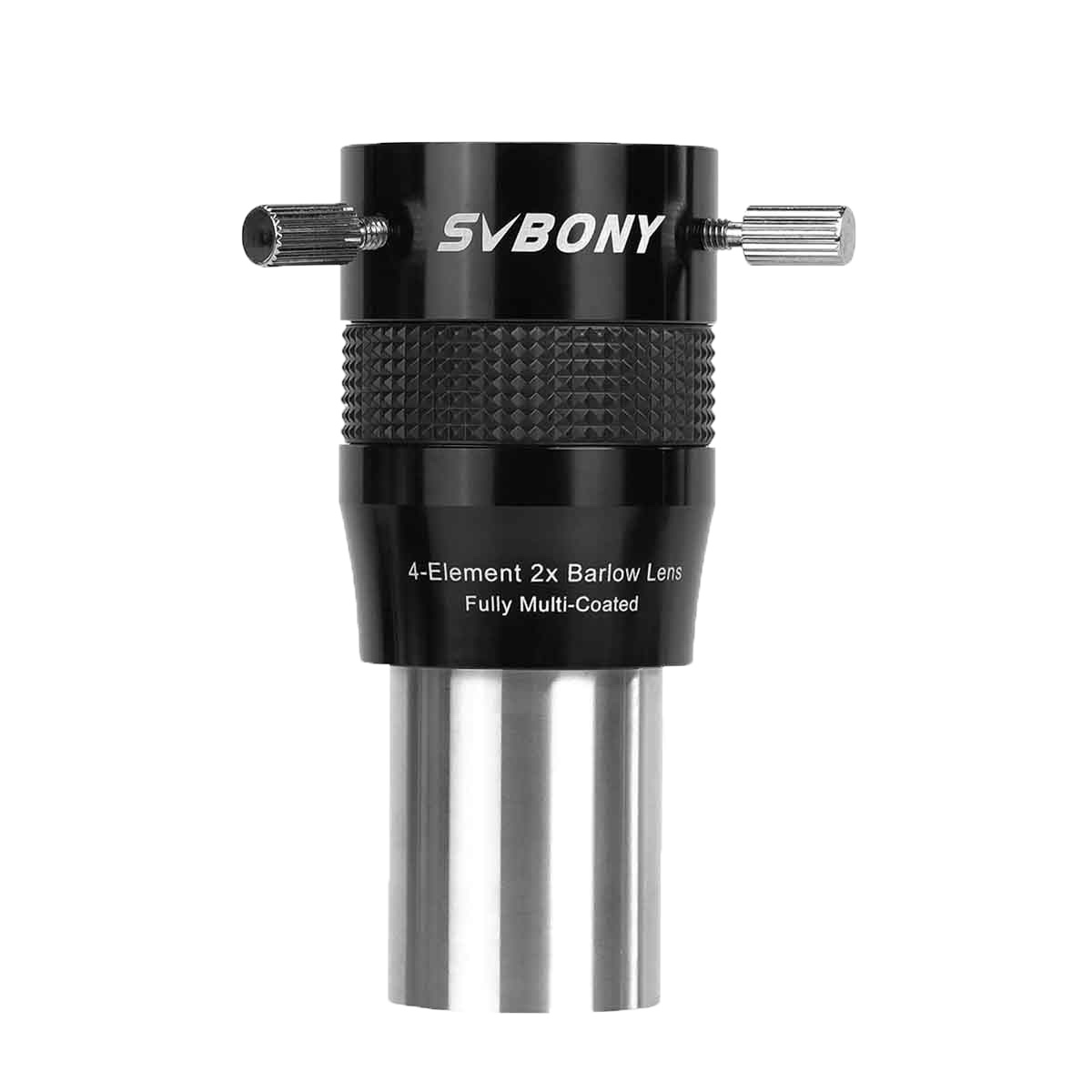
SVBony SV216 2x Barlow Lens — image 1
SVBony

SVBony SV216 2x Barlow Lens

2x Barlow · 4 elements · 1.25 inch · W9168A

Doubles the magnification of any eyepiece you put in it, so a two-eyepiece kit behaves like a four-eyepiece one. Four elements rather than the usual two, which is why it holds up at high power.

80/ 100
Polaris Score
The four-element Barlow at a two-element price
From$59.99
Where to buy
Affiliate link — we earn a commission, you pay the same. We rank on fit, not payout.
What problem does this solve?

Two eyepieces, four magnifications.

Eyepieces are the expensive part of a telescope kit, and the magnifications you want are not evenly spaced. Most people end up with a low power finder eyepiece and a mid power one, and then discover the planets want something shorter still, which is another purchase at another eighty dollars.

A Barlow multiplies the magnification of whatever eyepiece sits in it. A 2x in front of an 18 mm makes it behave like a 9 mm, and in front of a 10 mm makes it a 5 mm. Two eyepieces plus a Barlow gives four working magnifications, and it does so while keeping the comfortable eye relief of the longer eyepiece, which a genuinely short eyepiece would not.

You need one if
You need one as soon as your shortest eyepiece is not reaching the magnification the planets deserve on a steady night.
You can skip it if
Skip it if you observe only deep sky at low power, where doubling magnification halves the field and darkens the image for nothing you wanted.
How it actually works

What the setup looks like.

A Barlow is a diverging lens that sits before the eyepiece and stretches the light cone. Using one is simple, with one thing worth knowing:

A Barlow is a diverging lens that sits before the eyepiece and stretches the light cone. Using one is simple, with one thing worth knowing:

1
Drop it into the focuser
The 1.25 inch barrel goes where an eyepiece normally sits, held by the focuser's own thumbscrew.
2
Put the eyepiece into the Barlow
Three thumbscrews and a compression ring hold it without marking the barrel, which matters if your eyepieces are the expensive kind.
3
Refocus
A Barlow shifts the focal point outward, so expect to rack the focuser in noticeably from where the eyepiece alone focused.
4
Judge the night, not the eyepiece
Doubling magnification also doubles how visible the atmosphere's turbulence is. On a poor night the un-Barlowed view will be the better one.

The filter thread on the front takes standard 1.25 inch filters, so a Moon filter can live on the Barlow rather than being moved between eyepieces.

01Will it fit my setup

Compatibility.

What this accessory works with — check the fit before you check the price.

What this accessory works with — check the fit before you check the price.

Any 1.25 inch eyepiece1.25 inch focusers and star diagonalsPlanetary cameras with a 1.25 inch nosepieceStandard 1.25 inch filters on the front thread
Note✕1.25 inch only, so a 2 inch eyepiece will not fit✕Doubling magnification halves the true field and dims the image✕Adds length to the train, so a short-travel focuser may run out✕At 219 grams it is heavy, and with an eyepiece on top can unbalance a light mount
02The numbers

What These Numbers Mean

5 numbers in plain English · full specifications

5 numbers in plain English · full specifications

Element countWell corrected
4 elements
This is what separates a good Barlow from the reputation Barlows have. A cheap two element design introduces its own colour error and softens the edge, which is why experienced observers used to warn against them. Four elements correct the aberrations the amplification would otherwise introduce, so the doubled image stays as sharp as the eyepiece alone was.
MagnificationThe useful factor
2x
Two is the factor that pairs sensibly with a normal eyepiece set. It turns an 18 mm into an effective 9 mm and a 10 mm into a 5 mm, which fills the gaps most kits have. A 3x sounds better and in practice pushes past what the atmosphere supports on all but a handful of nights a year.
Eye relief effectThe hidden benefit
Preserved
This is the advantage people miss. A genuine 5 mm eyepiece has cramped eye relief, often five millimetres, which is unpleasant. Barlowing a 10 mm gives you 5 mm of magnification while keeping the 10 mm's comfortable eye relief, so you get the power without the eyelash-on-glass experience.
RetentionConsiderate
3 screws, compression ring
A single thumbscrew bearing directly on an eyepiece barrel leaves a dent, and over time a dented barrel sits crooked. A compression ring spreads the pressure around the whole circumference, holding the eyepiece square and leaving no mark. On a budget accessory this is a sign someone was paying attention.
Weight and lengthSubstantial
219 g, 59.5 mm
A Barlow adds its own length and mass to the focuser, and an eyepiece sits on top of that. On a small alt-azimuth mount the combination can be enough to shift the balance, and on a focuser with limited outward travel the added optical length occasionally means you cannot reach focus at all.
Optical
Magnification2x
Elements4
CoatingsFully multi-coated
Filter threadM28.5 x 0.6
Build
Barrel size1.25 inch
Barrel typeStraight, stainless steel
Insertion depth39.5 mm
Length59.5 mm
Weight219 g
Retention3 thumbscrews with compression ring
03Before you buy

Good to know.

The honest caveats — the things that save you a return, a bad first night, or a second purchase you didn't need.

The honest caveats — the things that save you a return, a bad first night, or a second purchase you didn't need.

Four elements is the specification that matters.
Barlows earned a poor reputation from cheap two element versions that visibly softened the image. A four element design is a different thing, and it is why this one is worth owning where a bargain Barlow is not.
It is a fair-weather accessory.
Doubling magnification also doubles how much atmospheric turbulence you see. On an average night the un-Barlowed view often shows more detail, and knowing when to leave it in the case is part of using one well.
Put your Moon filter on the Barlow.
The front filter thread means a neutral density filter can stay on the Barlow permanently rather than being unscrewed between eyepieces.
Check your focuser travel.
A Barlow moves the focus point outward. Most telescopes cope easily, but a Newtonian with limited inward travel occasionally will not reach focus with one fitted.
Editor’s Take

A Barlow is the highest leverage forty dollars in a beginner's kit and also the accessory most likely to be blamed unfairly. It gets blamed because doubling the magnification also doubles the visible effect of a turbulent atmosphere, and people conclude the glass is soft when the sky is. Buy a four element one, use it on the nights that deserve it, and it will effectively double the size of your eyepiece collection for the price of the cheapest eyepiece in it.

— The Skynocular verdict
80/ 100
SVBony SV216 2x Barlow Lens
2x Barlow · 4 elements · 1.25 inch · W9168A · $59.99

Doubles the magnification of any eyepiece you put in it, so a two-eyepiece kit behaves like a four-eyepiece one. Four elements rather than the usual two, which is why it holds up at high power.