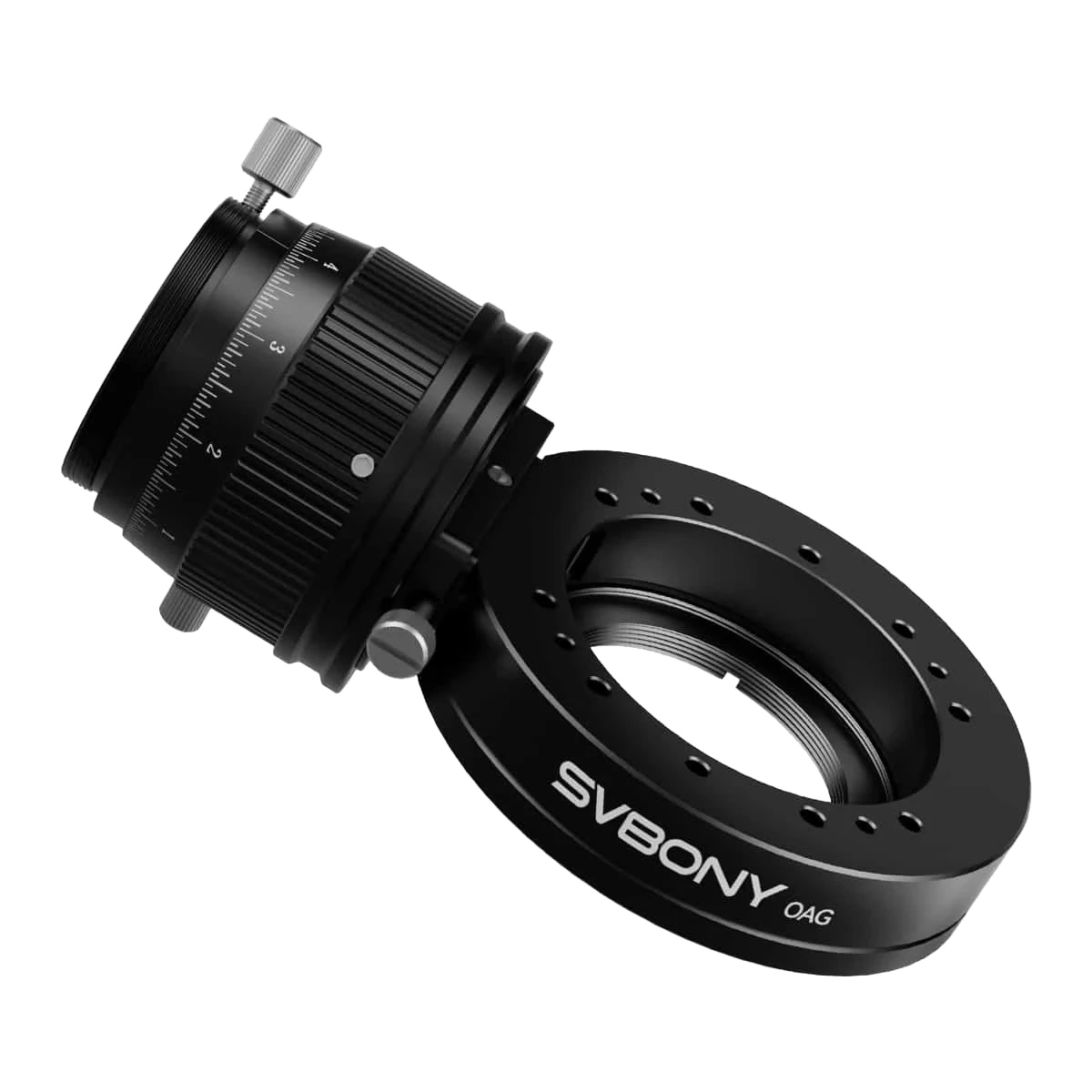
SVBony SV238 Off-Axis Guider
Guides through your main telescope's own optics instead of a second tube bolted on top. The answer for long Schmidt-Cassegrains, where a separate guide scope cannot see the errors that matter.
How it actually worksWhat the setup looks like.
An off-axis guider is a spacer with a prism in it. It goes into the imaging train, which is why setting one up takes more thought than clamping a guide scope on top:
What the setup looks like.
An off-axis guider is a spacer with a prism in it. It goes into the imaging train, which is why setting one up takes more thought than clamping a guide scope on top:
The prism looks at the very edge of the corrected field, where star shapes are at their worst. A slightly bloated or comatic guide star is normal here and does not stop the software finding its centre.
01Will it fit my setupCompatibility.
What this accessory works with — check the fit before you check the price.
Compatibility.
What this accessory works with — check the fit before you check the price.
02The numbersWhat These Numbers Mean
5 numbers in plain English · full specifications
What These Numbers Mean
5 numbers in plain English · full specifications
03Before you buyGood to know.
The honest caveats — the things that save you a return, a bad first night, or a second purchase you didn't need.
Good to know.
The honest caveats — the things that save you a return, a bad first night, or a second purchase you didn't need.
Off-axis guiding has a reputation for being difficult, and the reputation is half deserved. The setup genuinely is fiddlier: you are inserting an optical component into a train that has a fixed length, and then focusing two cameras to the same plane. What people underrate is that this is a one-time cost. Once the spacing is right and the guide camera is parfocal, an off-axis guider is the more reliable of the two approaches, because it has removed the failure mode rather than mitigated it. On a short refractor none of that matters and you should buy a guide scope. On a two metre Schmidt-Cassegrain, a guide scope is measuring the wrong thing carefully, and no amount of care fixes that.
Guides through your main telescope's own optics instead of a second tube bolted on top. The answer for long Schmidt-Cassegrains, where a separate guide scope cannot see the errors that matter.