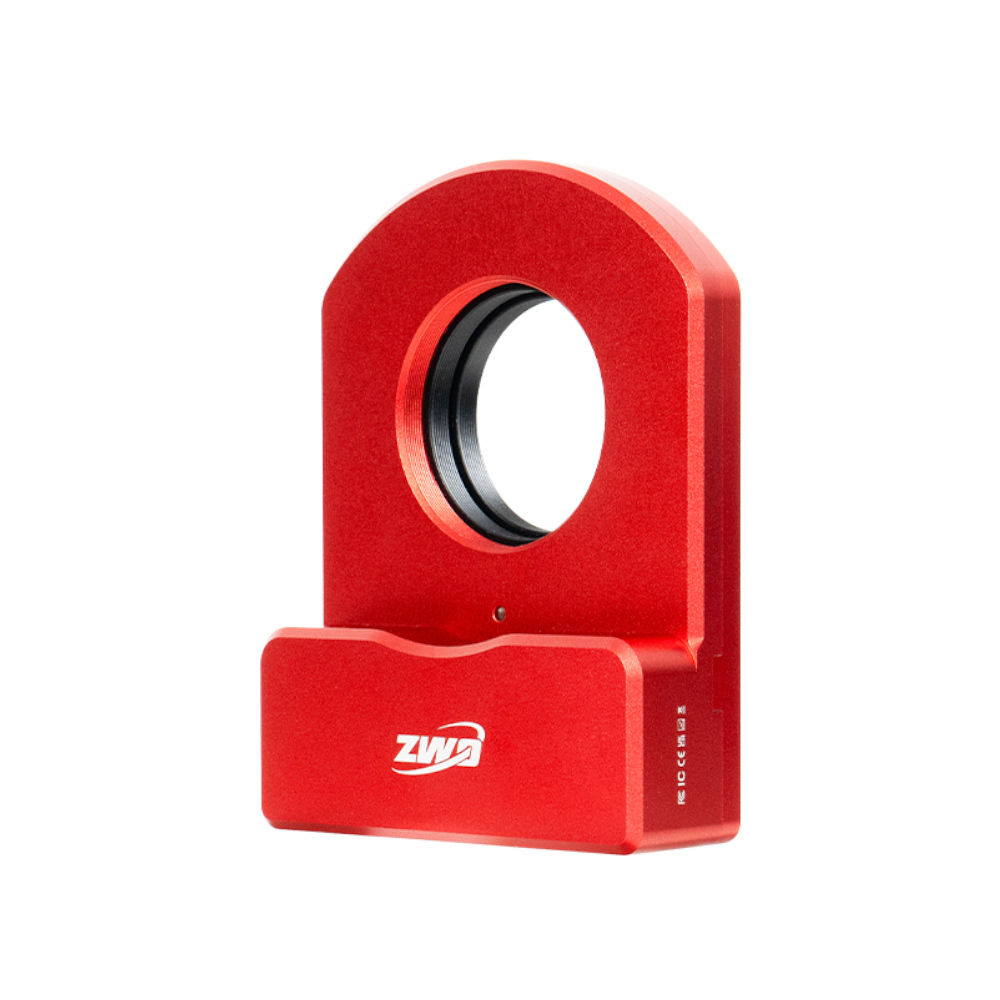
ZWO CAA Camera Angle Adjuster Electronic Rotator — image 1
ZWO

ZWO CAA Camera Angle Adjuster Electronic Rotator

Electronic rotator · M54 · 16.5 mm optical length · CAA-M54

A motorised ring in the image train that turns the camera to any angle and returns to the exact same angle on a later night.

83/ 100
Polaris Score
The rotator to buy if your rig is already ZWO end to end
From$399
Where to buy
Affiliate link — we earn a commission, you pay the same. We rank on fit, not payout.
What problem does this solve?

A camera sensor is a rectangle, and the sky does not care which way it points.

Most interesting deep sky targets are longer in one direction than the other. Point a rectangular sensor at the Veil Nebula or the Horsehead without thinking about angle and you crop off the end of the thing you came for, or you leave a third of the frame as empty sky. Rotating the camera thirty degrees is often the difference between a composition and a snapshot.

Doing that by hand is easy once. The trouble starts on the second night. Deep sky imaging is additive: you shoot the same target across many nights and stack the frames together, and that only works if every night is framed the same way. A camera loosened, twisted by eye and retightened will land a few degrees out, and the overlap between sessions shrinks each time until the stack has ragged edges and half the exposures wasted on sky you have to crop away.

A rotator makes the angle a number instead of a guess. The CAA sits between the telescope and the camera and turns the whole rear half of the image train under motor control, to a commanded angle, repeatably. Paired with an ASIAIR it goes further: it plate solves an old frame, works out what angle that frame was shot at, and rotates to match it within a tenth of a degree, without you knowing what the number was.

You need one if
You need one if you shoot the same deep sky targets across multiple nights, chase tight framing on elongated objects, or run the rig remotely where nobody can twist a camera by hand.
You can skip it if
You can skip it for planetary and lunar imaging, where the target is a small circle in the middle of the frame, and for anyone imaging a single night at a time who is happy to set the angle once and crop later.
How it actually works

What the setup looks like.

The CAA is a powered ring that becomes part of the image train, which means the arithmetic comes before the assembly:

The CAA is a powered ring that becomes part of the image train, which means the arithmetic comes before the assembly:

1
Spend the 16.5 mm first
The body adds 16.5 mm of optical length. Your flattener or reducer specifies a fixed distance to the sensor, usually 55 mm, and this takes a third of that budget. Add up your camera depth, filter drawer and adapters before ordering anything.
2
Thread it into the train
M54 female on the telescope side. On the camera side both an M54 male and an M48 male plate come in the box, so a ZWO cooled camera and a 2 inch filter drawer or wheel bolt straight on. An M42 plate is sold separately.
3
Run one USB-C
A single USB-C carries power and commands from an ASIAIR or a computer. A second port takes the EAF hand controller if you want to nudge the angle manually with nothing else connected.
4
Let it plate solve
In the ASIAIR app you either type an angle or point it at a previous image of the target. It solves the old frame, computes the difference, and rotates at 7.5 degrees per second until it matches.

Rotating the camera also rotates everything bolted behind it, cables included. Leave a service loop in the USB and power leads before the first full 360, or the rotator will unplug your camera for you.

01Will it fit my setup

Compatibility.

What this accessory works with — check the fit before you check the price.

What this accessory works with — check the fit before you check the price.

ZWO cooled camerasZWO 2 inch filter wheels & drawersASIAIRASIStudioASCOM (NINA and similar)M54 and M48 threads, both included
Note✕Costs 16.5 mm of a 55 mm back focus budget✕Ø48 mm clear aperture, sized for APS-C and smaller✕Fitting it and an off-axis guider together is an advanced build✕ZWO 36 mm filter wheel needs the separate M42 plate✕Hand controller sold separately
02The numbers

What These Numbers Mean

6 numbers in plain English · full specifications

6 numbers in plain English · full specifications

Optical lengthA third of your back focus
16.5 mm
This is the number that decides whether the CAA fits your rig at all. A flattener or reducer holds the sensor at a fixed distance, almost always 55 mm, and 16.5 of those millimetres now belong to the rotator. A ZWO cooled camera takes 17.5 mm and a 2 inch filter drawer around 20 mm, which lands you close enough to the limit that the sum has to be done on paper first.
Positioning accuracyRepeatable across nights
Better than 0.1°
A tenth of a degree of rotation moves a star at the corner of an APS-C sensor by roughly twenty microns, which is around four pixels. That is inside the error your stacking software already aligns away, so frames from different nights genuinely overlap instead of nearly overlapping.
Step resolutionFive steps per 0.1°
0.02° per step
The motor commands angles five times finer than the accuracy it promises, which is the right way round. The precision is limited by the mechanics settling rather than by how small a move it can make, so asking for an odd angle like 37.4 degrees is not a problem.
Clear apertureAPS-C comfortable
Ø48 mm
The hole light passes through is 48 mm across. An APS-C sensor has a 28 mm diagonal and sails through. A full frame sensor has a 43 mm diagonal, and with the rotator sitting some distance ahead of it the light cone for the corners is already wider than the hole, so expect vignetting at the extreme corners on a full frame camera.
Load capacityHolds a full train
5 kg (11 lb), over 2.5 N·m torque
It is carrying and turning everything behind it: filter wheel, off-axis guider, cooled camera, cables. A typical stack of those is 1.5 to 2.5 kg, so the motor is not working near its limit, which is why the angle stays put once the move has finished.
Rotation speedFull turn under a minute
7.5° per second
A complete 360 takes about 48 seconds, and a realistic framing correction of thirty degrees takes four. That matters more than it sounds: rotation happens between sub-exposures, so a slow rotator would spend your clear sky on moving rather than collecting.
Threads & optics
Telescope sideM54 female
Camera sideM54 male and M48 male, both included
M42 plateSold separately
Clear apertureØ48 mm
Optical length16.5 mm
Motion
Resolution0.02° per step
Positioning accuracyBetter than 0.1°
Rotation speed7.5° per second
Load capacity5 kg (11 lb)
TorqueOver 2.5 N·m
Connections & body
Data and powerUSB Type-C, single cable
Auxiliary portEAF hand controller, sold separately
SoftwareASIAIR, ASIStudio, ASCOM
Dimensions136 × 102 × 16.5 mm
Weight465 g (1.02 lb)
03Before you buy

Good to know.

The honest caveats — the things that save you a return, a bad first night, or a second purchase you didn't need.

The honest caveats — the things that save you a return, a bad first night, or a second purchase you didn't need.

The back focus arithmetic decides this purchase, not the price.
On a standard 55 mm imaging train, 16.5 mm for the rotator plus 17.5 mm for a ZWO cooled camera plus roughly 20 mm for a 2 inch filter drawer already fills the budget. There is no spare room for a surprise, so total your own train before you buy rather than after.
A rotator and an off-axis guider want the same space.
Both live in the short gap between flattener and sensor and there is rarely room for both. Petzval telescopes, which are not held to 55 mm, sometimes fit both. Otherwise the usual answer is a guide scope on top, or putting the rotator ahead of the reducer, which is an advanced build and not the intended one.
Automatic angle recall is really an ASIAIR feature.
The rotator turns to any angle from any ASCOM software. The trick everyone buys it for, pointing it at last week's image and having it match that framing by plate solving, lives in the ASIAIR ecosystem. Outside it you get accurate manual angles, which is still most of the value but not all of it.
Cables rotate with the camera.
Every lead behind the rotator turns when it turns. Dress them with a service loop and check a full 360 in daylight once, before the first night where a snagged USB ends the session at 1 a.m.
It is expensive for what it is.
Four hundred dollars is a ring with a motor in it, and it makes no image sharper. What it buys is repeatable framing across nights, which matters enormously if you build integration over weeks and not at all if you do not. Be honest about which of those you are.
Editor’s Take

The CAA is sold on precision and bought for patience. Nothing it does makes a single frame better, and on any one night you could get the same composition by loosening a thumbscrew and eyeballing it. What it changes is the shape of a project that runs over six nights instead of one: every session lands on the same rectangle of sky, the stack keeps its corners, and no data is thrown away for being framed three degrees off. If your imaging is a night at a time, this is a costly ring. If it is a campaign, it is the part that stops each night from being a fresh start.

— The Skynocular verdict
83/ 100
ZWO CAA Camera Angle Adjuster Electronic Rotator
Electronic rotator · M54 · 16.5 mm optical length · CAA-M54 · $399

A motorised ring in the image train that turns the camera to any angle and returns to the exact same angle on a later night.