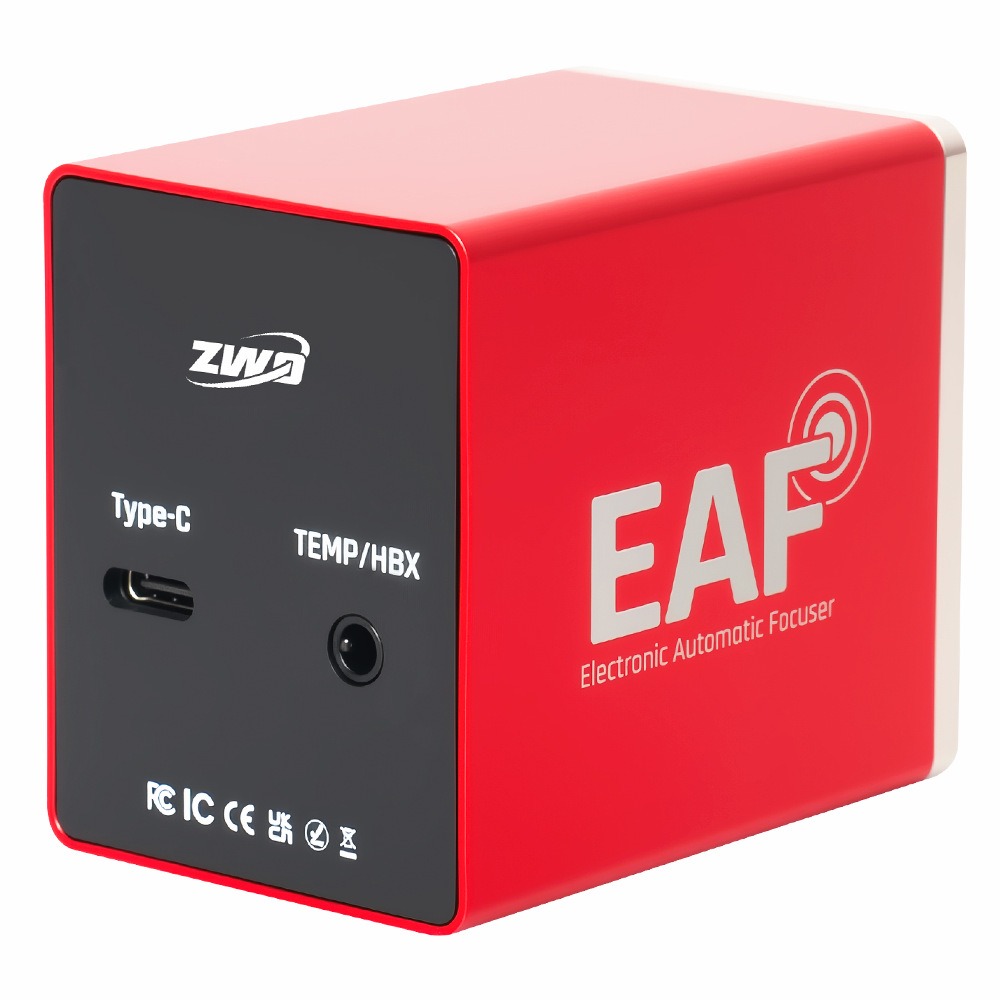
ZWO EAFN Electronic Automatic Focuser — image 1
ZWO

ZWO EAFN Electronic Automatic Focuser

Motorised focuser · 5 kg payload · USB-C · EAFN

A stepper motor that replaces your focus knob, so software can find perfect focus for you and hold it as the night gets colder.

90/ 100
Polaris Score
The default motor focuser almost every imaging rig ends up with
From$199
Where to buy
Affiliate link — we earn a commission, you pay the same. We rank on fit, not payout.
What problem does this solve?

Focus is not a setting you find once. It drifts all night.

A telescope focuses by moving the drawtube, and the window where stars are actually sharp is tiny: on a fast scope it is a few tens of microns, thinner than a sheet of paper. You can hit it by hand at the start of the session. What you cannot do by hand is hold it, because as the air temperature falls the aluminium tube contracts and quietly walks the focal point out of that window. An hour into a good night the stars are soft and nothing on the screen tells you why.

The other half of the problem is that touching the telescope to correct it is itself destructive. A hand on the focus knob shakes a mount that is trying to guide to one arcsecond, and the frame you were exposing is ruined. So the manual answer is to focus, walk away, and accept that the back half of the session is worse than the front half.

A motor focuser removes your hand from the loop. The stepper turns the drawtube in commanded increments, and your capture software runs an autofocus routine: it steps in, steps out, measures how fat the stars are at each position, and fits a V curve whose bottom is perfect focus. Then it repeats that automatically after a filter change, after a meridian flip, or every time the temperature drops a degree.

You need one if
You need one if you image unattended, use narrowband filters that are not parfocal, or have ever thrown away the second half of a night because the stars went soft.
You can skip it if
You can skip it for visual observing, for planetary video where you refocus constantly anyway, and for smart telescopes like a Seestar, which focus themselves internally.
How it actually works

What the setup looks like.

The EAF is a motor and a bracket. It becomes an autofocus system once your capture software can talk to it:

The EAF is a motor and a bracket. It becomes an autofocus system once your capture software can talk to it:

1
Take off one focus knob
The coarse knob unscrews from the focuser shaft. The EAF takes its place, so nothing is drilled or cut and the change is fully reversible.
2
Fit the coupling to the shaft
The included coupling clamps onto the bare 4 mm shaft with a 2 mm hex screw, and the motor shaft slides into the other end. Line the flat of the shaft up with the locking screw before you tighten it.
3
Bolt the bracket down
The bracket screws to the existing threaded holes in the focuser body with the supplied M4 screws. It has to sit flush and parallel, otherwise the motor fights the shaft instead of turning it.
4
Run one USB-C cable
A single USB-C carries both the 5 V it needs and the commands. It plugs into an ASIAIR or straight into a laptop, and the driver appears in ASCOM, INDI, NINA and SharpCap.

The 2025 EAF uses a 4 mm output shaft where the previous generation used 5 mm. If you already own a specialist bracket for a Takahashi or a Celestron SCT, check which coupling came in the box before you assume it fits.

01Will it fit my setup

Compatibility.

What this accessory works with — check the fit before you check the price.

What this accessory works with — check the fit before you check the price.

Crayford & rack-and-pinion focusersASIAIRASCOM (NINA, SGP, SharpCap)INDI / KStarsImage trains up to 5 kgUSB-C from a laptop or ASIAIR
Note✕SCT, Takahashi and some refractors need a brand-specific bracket, sold separately✕No buttons on the body: needs software or the optional hand controller✕Temperature sensor sold separately✕New 4 mm shaft, not the older 5 mm couplings
02The numbers

What These Numbers Mean

6 numbers in plain English · full specifications

6 numbers in plain English · full specifications

Step resolutionFiner than the focus window
2.812 µm per step
Each commanded step moves the drawtube under three thousandths of a millimetre. The zone where an f/5 telescope actually looks sharp is roughly fifty microns deep, so the whole in-focus range is about eighteen steps wide. That is the point: autofocus can sample across the good zone and pick its middle instead of guessing at it.
Gear reductionHigh torque
1:128
The stepper turns 7.5 degrees per pulse and the gearbox divides that by 128 before it reaches the shaft. That is where both the fine resolution and the holding torque come from, and it is why a loaded drawtube does not slowly sag back down once the motor stops.
PayloadCovers a full image train
5 kg (11 lb)
This is what the motor can lift and hold on the drawtube, not what your mount carries. A cooled camera, filter wheel, off-axis guider and rotator together usually land between 1.5 and 3 kg, so there is real headroom left even on a heavily loaded refractor.
Power and dataNo 12 V run
One USB-C at 5 V, 500 mA
Most observatory accessories want a 12 V barrel connector and a slot on your power box. This one does not: a single USB-C from the ASIAIR or the laptop carries both the power and the commands, which is one fewer cable to route through a mount that rotates.
Output shaftChanged this generation
4 mm
The previous EAF used a 5 mm shaft, and every third-party bracket and custom coupling sold before 2025 was cut for that. ZWO says a 5 mm coupling on a 4 mm shaft still works within tolerance, but it is a slip fit rather than a clamp, and it is the first thing to check if you are upgrading rather than starting fresh.
WeightHangs off the focuser
215 g
It bolts to the side of the drawtube, which is the far end of the lever from the mount, so it shifts the balance point backwards. On a small refractor you will want to slide the tube forward in its rings and rebalance once after fitting it, then never think about it again.
Motor
TypeStepper, 7.5° step angle
Reduction ratio1:128
Resolution≈2.812 µm per step
Payload5 kg (11 lb)
Output shaft4 mm
Connections
DataUSB Type-C
PowerUSB Type-C, 5 V 500 mA
Auxiliary port3.5 mm, for temperature sensor or hand controller
SoftwareASIAIR, ASIStudio, ASCOM, INDI
Physical
Dimensions41 × 52 × 70.3 mm
Weight215 g (7.5 oz)
MountingBracket and 4 mm coupling included
Tooling2 mm hex wrench and M4 screws included
03Before you buy

Good to know.

The honest caveats — the things that save you a return, a bad first night, or a second purchase you didn't need.

The honest caveats — the things that save you a return, a bad first night, or a second purchase you didn't need.

The temperature sensor is the cheap part that makes it smart.
Without it, autofocus only runs when you tell it to. With the 9.90 dollar probe taped to the tube, your software can watch the temperature and refocus itself every time it drops a degree. It is sold separately and it is the first thing you should add.
There is no way to focus by hand once it is on.
The EAFN has no buttons on its body. Focus commands come from an ASIAIR, a laptop, or the optional 39.90 dollar hand controller. If you also use the telescope visually and want a knob to turn, budget for the hand controller or look at the EAF Pro, which has buttons and a battery built in.
The bracket in the box does not fit everything.
It covers common Crayford and rack-and-pinion focusers. Celestron SCTs, Takahashi refractors and various other focusers need a specific bracket that ZWO or William Optics sell separately. Check which one your telescope needs before you order, not after.
Autofocus is a software feature, not a motor feature.
The motor only moves where it is told. The V curve routine that finds focus lives in ASIAIR, NINA, SharpCap or KStars. Any of them will drive this, but you do need one of them running, which means the EAF belongs on a rig that already has a computer or an ASIAIR in it.
Editor’s Take

Motor focusers get sold on precision, and precision is not really the point. You can hit focus by hand at the start of a session as well as any motor can. What you cannot do by hand is hit it again at two in the morning, after a filter change, without touching a telescope that is mid-exposure. The EAF is not a sharper focuser than you are. It is a focuser that is still paying attention four hours after you stopped.

— The Skynocular verdict
90/ 100
ZWO EAFN Electronic Automatic Focuser
Motorised focuser · 5 kg payload · USB-C · EAFN · $199

A stepper motor that replaces your focus knob, so software can find perfect focus for you and hold it as the night gets colder.