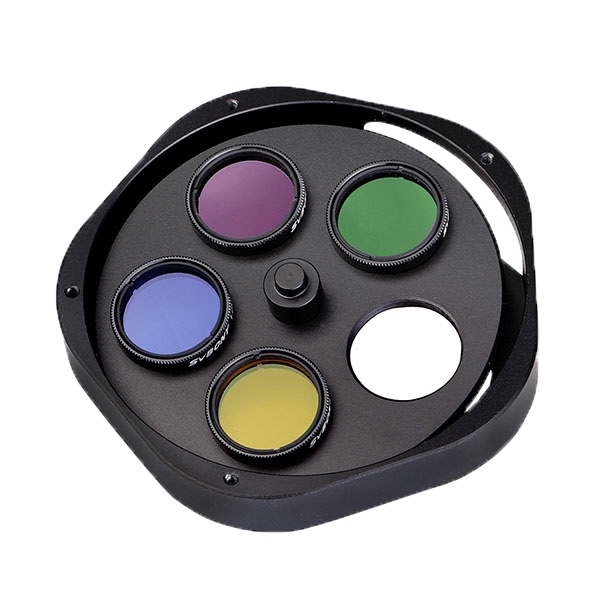
SVBony SV133 5-Position Filter Wheel — image 1
SVBony

SVBony SV133 5-Position Filter Wheel

Manual 5-position filter wheel · 1.25 inch filters · W9103A

Holds five 1.25 inch filters and turns the one you want into the light path. Manual, so you change filters by hand at the telescope.

70/ 100
Polaris Score
The budget entry into filter wheels, with real limits
From$67.50
Where to buy
Affiliate link — we earn a commission, you pay the same. We rank on fit, not payout.
What problem does this solve?

Five filters, one light path, and a lot of unscrewing.

Anyone who owns more than one filter has done the routine: unthread the camera, unscrew the filter, put it somewhere safe in the dark, thread on the next one, reassemble, refocus. It takes minutes, risks fingerprints on glass, and it is why most people with three filters mostly use one.

A filter wheel keeps all five mounted at once in a disc that rotates the chosen one into the beam. This is the manual version, so you turn it by hand rather than by software, but the filters stay mounted, the spacing never changes, and the change takes a second.

You need one if
You need one once you own three or more filters and have noticed you are choosing the filter based on how annoying it is to fit rather than on the target.
You can skip it if
Skip it if you own one or two filters, where a drawer is simpler and thinner, and skip it entirely if you are running an automated mono sequence, which needs a motorised wheel.
How it actually works

What the setup looks like.

A manual wheel is a mechanical part with no electronics. It goes into the imaging train and stays there:

A manual wheel is a mechanical part with no electronics. It goes into the imaging train and stays there:

1
Mount five filters in the carousel
Each position takes a 1.25 inch filter on a standard thread. Load it once at a desk, in the light, rather than at the telescope in the dark.
2
Fit it between telescope and camera
It becomes a permanent part of the train. Everything downstream of it has to be spaced accordingly.
3
Turn to the position you want
Detents mark each stop so the filter lands centred in the beam without you looking.
4
Refocus if you changed filter type
Different filters have slightly different thickness and refractive index, so focus can shift a little between them.

Manual means you are physically at the telescope for every change. If you image remotely or run unattended sequences, this is the wrong tool and a motorised wheel is the right one.

01Will it fit my setup

Compatibility.

What this accessory works with — check the fit before you check the price.

What this accessory works with — check the fit before you check the price.

1.25 inch threaded filtersSmall sensor cameras, up to roughly 4/3Planetary and lunar imaging with colour filtersVisual use with a diagonal, in some configurations
Note✕1.25 inch filters only, which will vignette a large sensor✕Manual operation, so no automated sequencing✕Adds back focus that has to be budgeted for✕At 351 grams it is heavy for its size and hangs off the focuser
02The numbers

What These Numbers Mean

5 numbers in plain English · full specifications

5 numbers in plain English · full specifications

OperationThe main limitation
Manual
This is the specification that decides whether the wheel suits you. Manual means a hand on the telescope for every filter change, which is fine for planetary work where you are sitting there anyway, and unworkable for a mono deep-sky sequence that cycles three filters unattended through the night. A motorised wheel costs three to four times as much and exists for exactly that reason.
Filter sizeSmall sensors only
1.25 inch
Filter size sets the largest sensor you can use without darkened corners. A 1.25 inch filter has roughly 27 millimetres of clear glass, which covers a 1 inch sensor comfortably and a 4/3 sensor with little to spare. An APS-C sensor will vignette. If your camera is larger than 4/3, this is the wrong wheel.
PositionsGenerous
5
Five is more than the classic four of luminance plus red, green and blue, so there is room for a narrowband filter or a UV/IR cut alongside a full colour set. For planetary work the fifth slot usually ends up holding a neutral density filter for the Moon.
WeightSubstantial
351 g
Three hundred and fifty grams is heavy for a component this size, and it all hangs off the end of the focuser on a long lever arm. On a solid rack and pinion focuser that is fine. On a lightweight Crayford it can cause visible droop, which shows up as stars that shift slightly when the telescope changes orientation.
DetentsRepeatable
One per position
The point of a detent is that the filter lands centred in the beam every time without you checking. That matters more than it sounds, because a filter sitting half in the light path vignettes one side of the frame in a way that looks like an optical fault rather than an assembly error.
Function
Positions5
Filter size1.25 inch
OperationManual
DetentsYes, one per position
Build
MaterialAluminium body
Weight351.5 g
ColourBlack
03Before you buy

Good to know.

The honest caveats — the things that save you a return, a bad first night, or a second purchase you didn't need.

The honest caveats — the things that save you a return, a bad first night, or a second purchase you didn't need.

Match the filter size to your sensor first.
1.25 inch filters and a 4/3 or larger sensor is the classic mismatch. Check your sensor diagonal against roughly 27 millimetres of clear aperture before buying either the wheel or a set of filters to fill it.
Manual is a real constraint, not a minor one.
If your plan is mono narrowband imaging with an automated sequence, this wheel cannot do it. That is not a defect, it is a different product category, and the price reflects it.
Expect a small focus shift between filters.
Filters differ slightly in thickness and refractive index, so the focal point moves a little as you change them. Check focus after each change rather than assuming it holds.
Load it indoors.
Threading five filters into a carousel is a fiddly job. Do it once at a desk, and the whole point of the wheel is that you never do it again in the field.
Editor’s Take

Manual filter wheels occupy an odd position. They solve the mechanical annoyance of changing filters without solving the workflow problem of changing them unattended, which means they suit planetary imagers and visual observers far better than the mono deep-sky imagers who are usually pictured buying one. If you are at the telescope anyway, this is a genuine convenience for very little money. If your ambition is to set a sequence running and go to bed, this will not get you there and no amount of saving on it will help.

— The Skynocular verdict
70/ 100
SVBony SV133 5-Position Filter Wheel
Manual 5-position filter wheel · 1.25 inch filters · W9103A · $67.50

Holds five 1.25 inch filters and turns the one you want into the light path. Manual, so you change filters by hand at the telescope.