Unistellar ENVISION Smart Binoculars — image 1
Unistellar

Unistellar ENVISION Smart Binoculars

10x50 · 6.5° true field · AR overlay · ENV_01

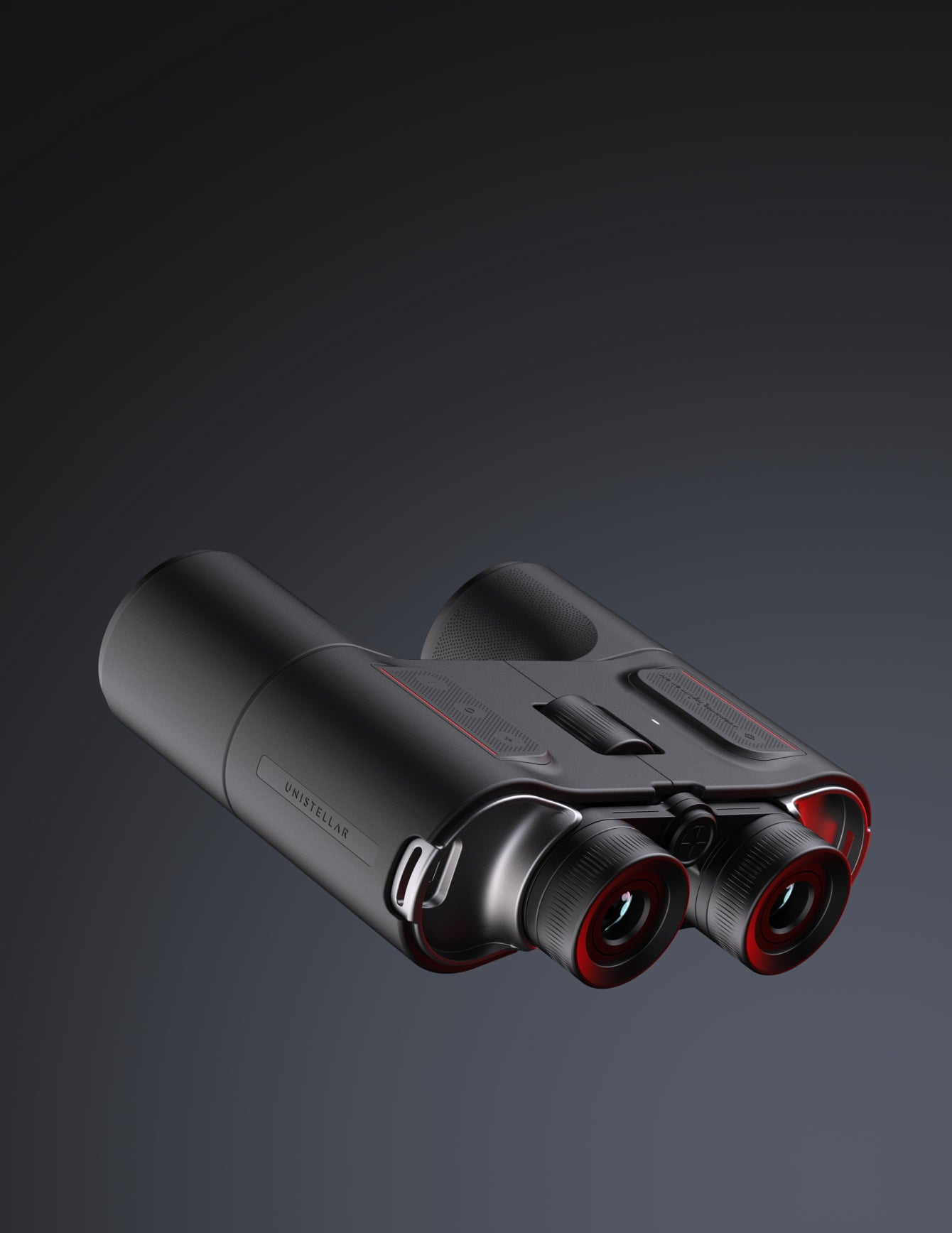
A conventional 10x50 porro binocular with a red display projected into the right eyepiece, so the thing you just swept past arrives with its name attached.

76/ 100
Polaris Score
The only binocular that tells you what you are looking at
From$1,499
Where to buy
Affiliate link — we earn a commission, you pay the same. We rank on fit, not payout.
The true field

A telescope shows you a keyhole. This shows you the room.

The overlay names what is in the circle, so the size of the circle decides how much it can name at once. At 6.5 degrees this pair holds star patterns whole, which is what lets you sweep and read rather than hunt and check.

6.5° true field
Fills the field

The V of Taurus just fits, edge to edge, with the labels for Aldebaran and the brighter members arriving together. This is close to the largest single thing the field can frame.

Sizes are drawn to scale against the true field. The targets themselves are illustrations, not photographs.

What problem does this solve?

You can find it. You still cannot name it.

The standard advice to a beginner is to buy binoculars first, and it is good advice: a 10x50 shows more sky in a night than a telescope shows in a week. What nobody warns you about is the second problem. You sweep along the Milky Way, something fuzzy drifts through the circle, and you have no way of knowing whether it was a globular cluster, a nebula, or a smear of unresolved stars. So you lower the binocular, open a phone, destroy your dark adaptation, and by the time your eyes recover you have lost the spot.

ENVISION puts the answer inside the view. A red OLED panel in the right eyepiece draws over about 85 percent of the field, and compass, gyroscope and magnetometer readings tell it where the barrels are pointing. Sweep past M13 and the label is already there. It never films anything and it never reconstructs the image: you are looking through ordinary glass at the real sky, with text laid over it. That distinction matters, because it means the view does not lag, pixelate, or die when the battery does.

The same machinery works in daylight, which is the part most astronomy buyers will not expect. Point it at a ridgeline and you get peak names, elevations and distances. That is a fair chunk of what you are paying for, and if you will never use it, the value calculation changes.

You need one if
You are past the "which end do I point up" stage and stuck at the "what was that" stage, you observe alone without anyone to identify things for you, or you want to hand a group the sky without narrating every target yourself.
You can skip it if
You already know the sky. If you can find M31, M13 and the Double Cluster from memory, the overlay is telling you what you were going to say anyway, and $1,499 buys a genuinely excellent 10x50 plus a 15x70 for the deep sky plus a good tripod, with change. This is also the wrong instrument if you want more reach: 50 mm is 50 mm, and no display adds photons.
How it actually works

What the setup looks like.

The optics need the same three adjustments as any binocular. The overlay needs one more, and skipping it is why a first night can feel like the labels are drifting.

The optics need the same three adjustments as any binocular. The overlay needs one more, and skipping it is why a first night can feel like the labels are drifting.

1
Set the hinge and the diopter
Fold the barrels until the two circles merge into one, then focus the center wheel on a bright star with your right eye covered, and finish with the left eyepiece dioptric ring. Do this before you judge anything about the display, because the overlay is focused at the same plane as the sky.
2
Pair the app over Bluetooth
The phone carries the target catalog and the regional map data. Download the region you are travelling to while you still have signal, because everything after this point works offline.
3
Anchor the overlay
A short pointing gesture at a known reference tells the sensors where north and level are. There is no camera doing plate solving, so the alignment is only as good as the gesture and the local magnetic field. Redo it if you have been standing near a car.
4
Sweep, then center
Names appear as objects pass through the field. Center one and hold it to open the longer description. TargetLock hands the same object to another pair, which is the feature that changes what a group session feels like.

One battery charge covers about five hours, or roughly a thousand label engagements. USB-C, so the power bank already in your bag is the answer to a long night.

01Will it fit my setup

Compatibility.

What this accessory works with — check the fit before you check the price.

What this accessory works with — check the fit before you check the price.

Runs entirely offline once regional sky and map data are downloaded, so a dark site with no cell signal is the intended use, not a compromise.Tripod mountable through a standard adapter, which is worth doing for a long look and essential if you are handing the view around.IP54 and rated from minus 10 to 55 degrees C, so a cold clear night and a heavy dew are within spec.English, French, German and Japanese at launch, with Spanish and Italian stated as coming.Daylight use is a first-class mode, not an afterthought: peaks, ridgelines, trails, lakes, with elevations and distances.
Note✕The overlay lives in the right eyepiece only. Your left eye sees clean sky, your right sees sky plus red text, and some people take a few sessions to stop noticing that.✕Eye relief is 11.8 mm. That is short for eyeglass wearers, who will likely lose the field edges, and the AR panel is not something you can compensate for with a different eyepiece.✕No image stabilization. At 10x your pulse is in the view exactly as it is in any other handheld binocular, and the labels do not steady the stars.✕No camera and no imaging. This is the opposite end of the Unistellar line from the eVscope: nothing is recorded, nothing is stacked, and there is no astrophotography here at all.✕Orientation is sensor-based, so a nearby car, a steel railing or a bad anchoring gesture puts the labels off target. It is dead reckoning, not plate solving.✕Pre-order at the time of writing, with delivery stated for the end of November 2026 and a 500 unit batch. You are buying a promise with a 30 day refund behind it.
02The numbers

What These Numbers Mean

5 numbers in plain English · full specifications

5 numbers in plain English · full specifications

True field of viewWide enough to keep your bearings
6.5°
This is how much sky sits inside the circle at once, and for a labeling instrument it matters twice over. Six and a half degrees holds the Belt of Orion with room around it and frames the Pleiades against dark sky, so star patterns stay recognizable while you sweep. It also sets how many objects the overlay can name in one view: a wider circle means more labels arrive per pass, which is what makes browsing feel like reading rather than hunting. For reference, a telescope at low power shows about one degree.
AR displayRed on purpose, right eye only
960 x 960 red OLED
Red is the one color that leaves dark adaptation intact, which is why observers use red flashlights and why the panel is not white. The resolution is enough for crisp text and bearing scales rather than pictures, and it covers about 85 percent of what you see through the right barrel. Because it sits in one eyepiece only, your left eye keeps a completely unobstructed view of the real sky. That split is deliberate and it is also the thing most likely to take you a session or two to get used to.
Exit pupilMatched to a dark-adapted eye
5 mm
Divide the objective by the magnification and you get the width of the beam leaving the eyepiece. At 5 mm it fits just inside a dark-adapted pupil, so none of the light those 50 mm objectives collect is wasted on your iris, and small head movements do not black out the view. Under a suburban sky a wider beam would only deliver more skyglow. This is the ordinary, correct answer for a 10x50, and it is worth saying plainly that the AR layer changes nothing about it.
Eye reliefTight if you wear glasses
11.8 mm
Eye relief is how far behind the eyepiece your pupil can sit and still take in the whole field. Below roughly 15 mm, eyeglass wearers get a tunnel: the lenses hold their eyes too far back and the edges disappear. At 11.8 mm that is a real risk, and on this binocular it costs you overlay area as well as sky. If you are astigmatic and cannot observe without correction, try before you commit, because no eyepiece swap is available to fix it.
Battery lifeA full night, with a power bank as insurance
5 hours
Quoted as five hours or about a thousand label engagements, which is a more useful figure because the display only draws power when it is actually telling you something. Sweeping without centering costs very little. A serious session rarely runs past four hours before dew or cold ends it, so this covers a normal night with margin. It charges over USB-C, so the same battery pack that keeps your phone alive keeps the overlay alive, and the optics themselves work perfectly well with a flat battery.
Optics
Magnification10x
Objective50 mm
True field of view6.5°
Exit pupil5 mm
Eye relief11.8 mm
PrismPorro
Glass and coatingsBAK4, fully multi-coated
Dioptric correctionLeft eyepiece
Augmented reality
Display960 x 960 OLED matrix
ColorRed
Field coverage85% of the field
EyeRight eyepiece only
SensorsCompass, gyroscope, magnetometers, ambient light
Catalog1,000+ celestial targets, 200,000 stars, plus topographic and cartographic data
Power and connectivity
Battery1,100 mAh
Runtime5 hours, or 1,000 engagements
ChargingUSB-C
WirelessBluetooth BLE
OfflineYes, with regional data downloaded
Physical
Weight1.1 kg (2.43 lb)
Dimensions185 x 190 x 70 mm
Interpupillary range56 to 72 mm
BodyGlass-fiber reinforced plastic, armored rubber
Weather ratingIP54
Operating temperature-10 to 55 °C
Tripod mountableYes, with adapter
Warranty
OpticsLifetime
Electronics2 years from delivery
ReturnsRefundable in full for 30 days after delivery
03Before you buy

Good to know.

The honest caveats — the things that save you a return, a bad first night, or a second purchase you didn't need.

The honest caveats — the things that save you a return, a bad first night, or a second purchase you didn't need.

The glass is good, not exceptional, and that is the trade
BAK4 porro prisms with full multi-coating is a solid, conventional recipe, and a porro design usually gives a slightly more three-dimensional view than a roof prism at the same price. But premium 10x50s at a third of this price use ED glass and hold their edges better. You are paying for the electronics, so judge the purchase on whether the labels are worth it to you.
Magnetic surroundings will lie to it
Orientation comes from magnetometers and gyroscopes, with no camera checking the result against the actual star field. Standing next to a car, a metal gate or a steel tripod head can push the labels off target. If the names stop matching what you know is up there, re-anchor somewhere clear rather than assuming the catalog is wrong.
Download your region before you leave
The offline database is the whole point for a dark site, but it has to be pulled over the phone first. A trip out to a park with no signal and no downloaded map is the one way to end up with an expensive ordinary binocular for the night.
TargetLock is the feature to actually try
Handing a locked target from one pair to another sounds like a spec sheet line and turns out to be the thing that changes a group session. Pointing at the sky and saying "just left of the bright one" is how most people lose a target. Passing the lock removes that conversation entirely.
Pre-order means the review record is thin
Mass production began in May 2026 and the current batch is stated as 500 units delivering end of November. There is not yet a body of long-term field reports on how the overlay holds up in deep cold, heavy dew, or after a season of handling. The 30 day full refund is what makes that risk reasonable rather than reckless.
Editor’s Take

Every other binocular on this site is sold on how much light it gathers. This one is sold on how much you know, and that is a genuinely new axis for the category. The question to sit with is not whether the overlay works, because by all accounts it does. It is whether being told the name of a thing is what was missing from your nights. For someone starting out alone, with no club and no one to point, it plausibly is. For anyone who has already built the map in their own head, this is a very expensive way to be told what they already know.

— The Skynocular verdict
76/ 100
Unistellar ENVISION Smart Binoculars
10x50 · 6.5° true field · AR overlay · ENV_01 · $1,499

A conventional 10x50 porro binocular with a red display projected into the right eyepiece, so the thing you just swept past arrives with its name attached.