SVBony SV241 Astronomy Power Box — image 1
SVBony

SVBony SV241 Astronomy Power Box

12 V distribution and USB hub · 6 DC out, 2 USB 3.1 · W9193E

One 12 volt input becomes six outputs and a two-port USB hub, mounted on the telescope. Replaces the bundle of cables running from the mount to the ground.

78/ 100
Polaris Score
The cheapest cure for cable chaos on a moving telescope
From$69.99
Where to buy
Affiliate link — we earn a commission, you pay the same. We rank on fit, not payout.
What problem does this solve?

Every cable that reaches the ground is a cable that can snag.

A working imaging rig needs power for the mount, the cooled camera, a dew heater or two and often a focuser, plus USB back to a computer for the camera and the guider. Run all of that from the ground and you have six or seven leads draped across a telescope that rotates through the night. Sooner or later one catches, and the best case is a ruined subframe.

A power box mounts on the telescope and moves the distribution point up there with it. One 12 volt lead and one USB lead come up from the ground, and everything else is a short jumper that turns with the rig. Nothing that moves is connected to anything that does not.

You need one if
You need one when your rig has more than about three powered devices, or the first time a cable snag ends a session.
You can skip it if
Skip it if you image with a camera and a tracker and nothing else, since two cables do not need managing, and skip it if what you actually lack is battery capacity rather than distribution.
How it actually works

What the setup looks like.

The box is a passive distributor with a USB hub in it. There is nothing to configure:

The box is a passive distributor with a USB hub in it. There is nothing to configure:

1
Mount it on the telescope or the saddle
It has to move with the rig, otherwise it solves nothing. Most people strap it to the dovetail or the tube rings.
2
Feed it 12 volts
One 5.5 by 2.5 millimetre barrel input rated to 10 amps, from a mains supply or a battery on the ground.
3
Fan out the short leads
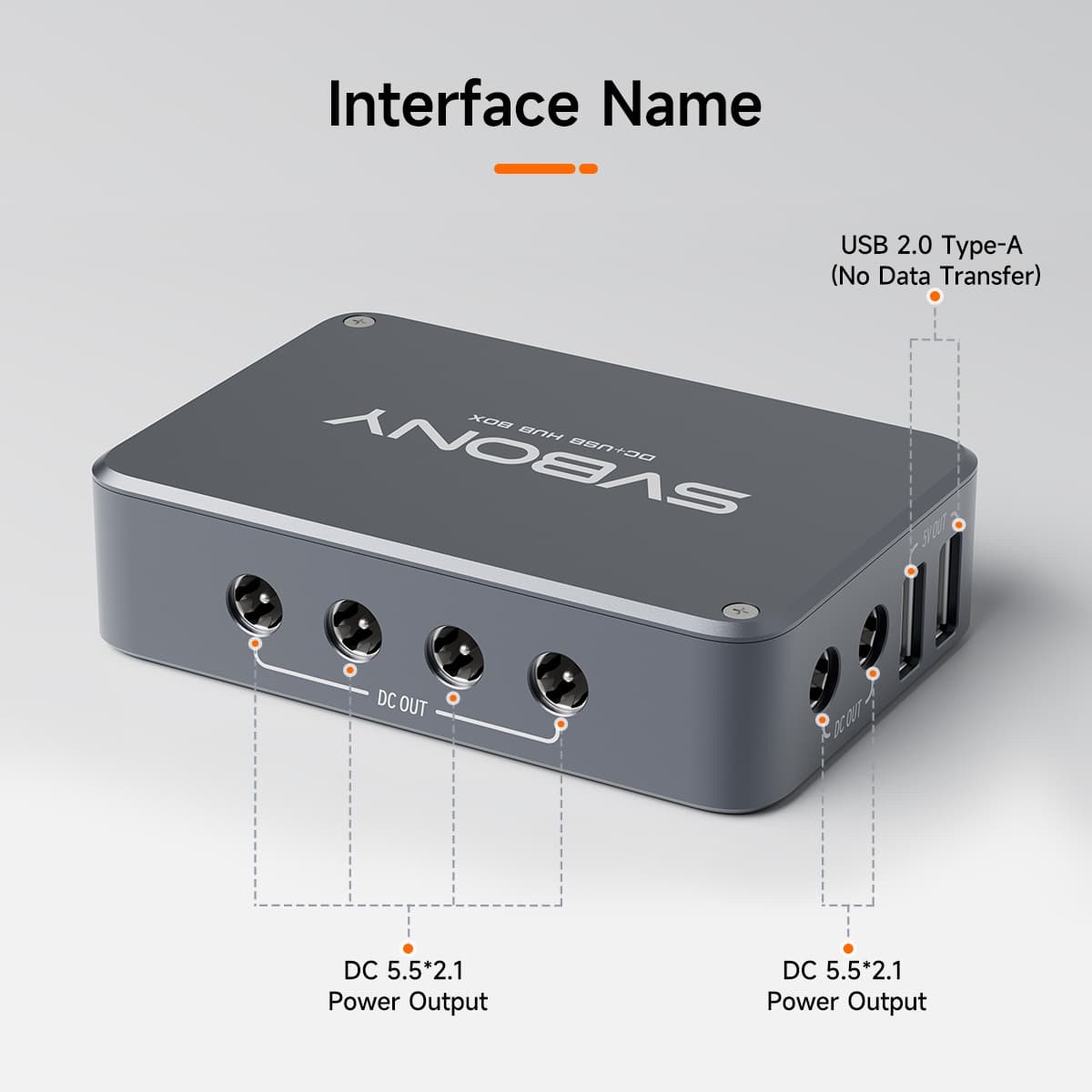
Six 12 volt outputs on the common 5.5 by 2.1 millimetre barrel run the mount, camera cooler, dew heaters and focuser with short jumpers.
4
Run one USB to the computer
A USB Type-B uplink carries both USB 3.1 ports back to a single lead, so the camera and guider share one cable to the ground.

It distributes power, it does not generate or regulate it. What comes out is what you put in, so a sagging battery will still brown out your mount.

01Will it fit my setup

Compatibility.

What this accessory works with — check the fit before you check the price.

What this accessory works with — check the fit before you check the price.

Any 12 volt astronomy device on a 5.5 by 2.1 mm barrelCameras and guiders over USB 3.1Dew heater bandsMounts drawing up to the shared 10 amp budget
Note✕Passive distribution, so it adds no capacity and no regulation✕The 10 amp input is shared across all six outputs✕No individual port switching or dew heater control✕Needs mounting hardware suited to your tube or saddle
02The numbers

What These Numbers Mean

5 numbers in plain English · full specifications

5 numbers in plain English · full specifications

DC outputsGenerous
6 at 12 V
Six outputs is more than most rigs need, which is the point: the mount, a cooled camera, two dew heaters and a focuser is five, and the spare means the box does not become the reason you cannot add something. All six share the same input, so count amps rather than ports when planning.
Input ratingThe real ceiling
12 V, 10 A
Ten amps is the total for everything downstream, not per port. A cooled camera at full cooling draws three to four, a mount slewing draws two, and dew heaters take one to two each. A busy rig can approach the limit on a cold night, and the failure mode is a brownout that resets the mount mid-sequence.
USB hubEnough for camera and guider
2 x USB 3.1
Two ports covers the standard pairing of an imaging camera and a guide camera, which is what turns six cables into two. USB 3.1 has the bandwidth for a cooled camera downloading full frames, and the single Type-B uplink means only one data cable reaches the ground.
ProtectionPresent
ESD, reverse polarity, over-voltage
This matters more in the field than it sounds. Barrel connectors are easy to insert the wrong way in the dark, and a reverse polarity event without protection can destroy a cooled camera worth ten times this box. Protection circuitry is the quiet reason to buy a purpose-built distributor rather than a splitter cable.
RegulationKnow this
None, passive
The box distributes what it is given and does not regulate it. If your battery sags to 11 volts under load, every device downstream sees 11 volts. That means a power box does not fix an underpowered setup, and diagnosing brownouts still means looking at the supply rather than the distributor.
Power
Input12 V DC, 5.5 x 2.5 mm, 10 A
DC outputs6 x 12 V, 5.5 x 2.1 mm
DC capability12 V, 10 A shared
USB power5 V, 8 A
Data
USB ports2 x USB 3.1 Type-A
UplinkUSB Type-B to Type-A
IndicatorPower LED
Protection
ESDYes
Reverse polarityYes
Over-voltageYes
Over-currentUSB ports
03Before you buy

Good to know.

The honest caveats — the things that save you a return, a bad first night, or a second purchase you didn't need.

The honest caveats — the things that save you a return, a bad first night, or a second purchase you didn't need.

It fixes cable management, not power supply.
If your mount resets or your cooler cannot reach its set point, the problem is the battery or the supply, and adding a distributor will not change it. Buy this to stop snags, not to stop brownouts.
Mount it on the moving part.
The whole benefit comes from the distribution point turning with the telescope. Strapped to a tripod leg it is just a splitter with extra steps.
Budget your amps, not your ports.
Six outputs share one ten amp input. Add up the draw of a cooled camera, the mount and your dew heaters before assuming everything can run at once on a cold night.
No dew heater control.
The 12 volt outputs are straight through, so a dew band runs at full power or not at all. If you want variable dew control, you want a dew controller as well as this.
Editor’s Take

Power boxes are the least glamorous purchase in astrophotography and one of the few that reliably increases how many usable frames you get. Nothing about the image improves. What improves is that the session finishes, because the cable that used to catch on the tripod leg at meridian flip is now a ten centimetre jumper that turns with the telescope. Buy it when cable drag has cost you a night, which for most people is about six months into imaging.

— The Skynocular verdict
78/ 100
SVBony SV241 Astronomy Power Box
12 V distribution and USB hub · 6 DC out, 2 USB 3.1 · W9193E · $69.99

One 12 volt input becomes six outputs and a two-port USB hub, mounted on the telescope. Replaces the bundle of cables running from the mount to the ground.