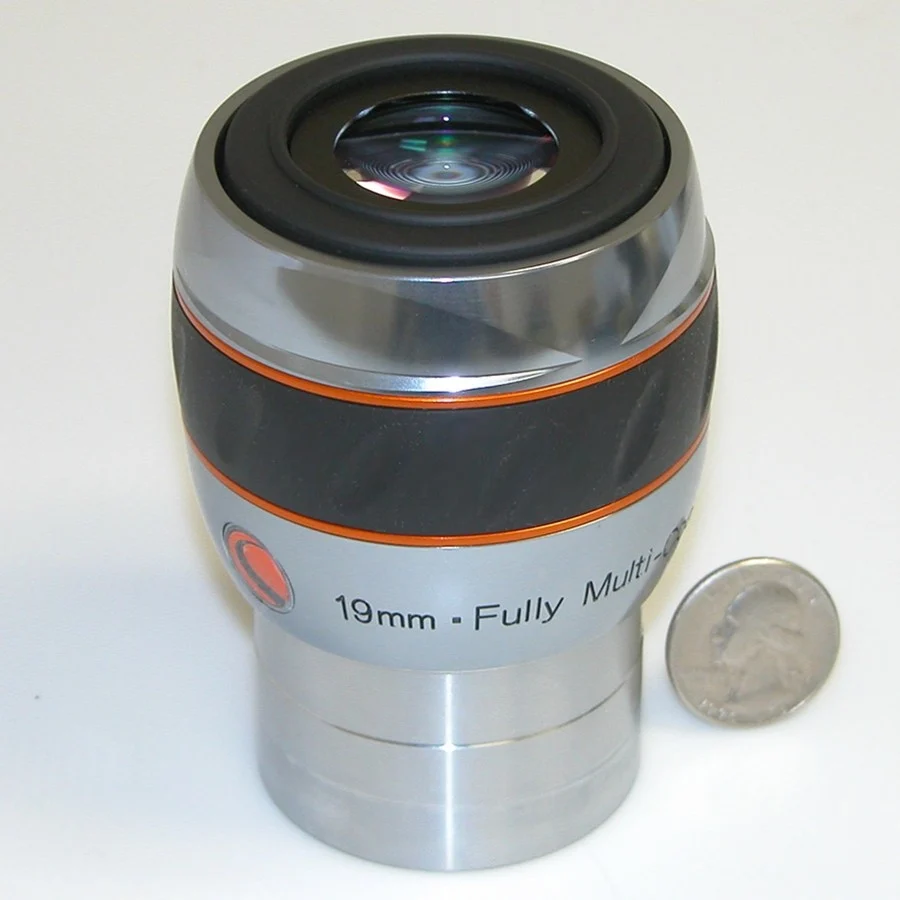
Celestron Luminos 19mm — image 1
Celestron

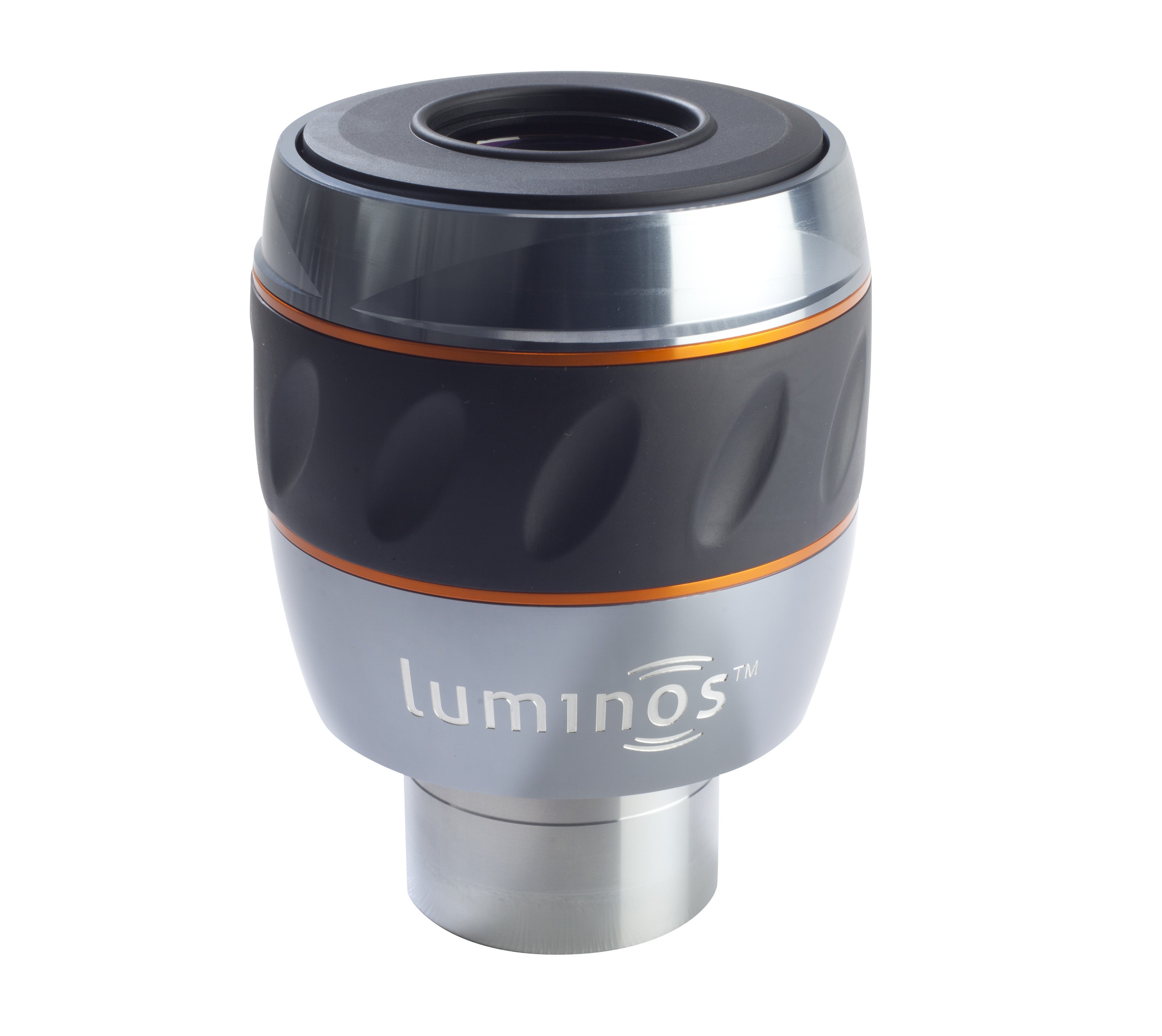
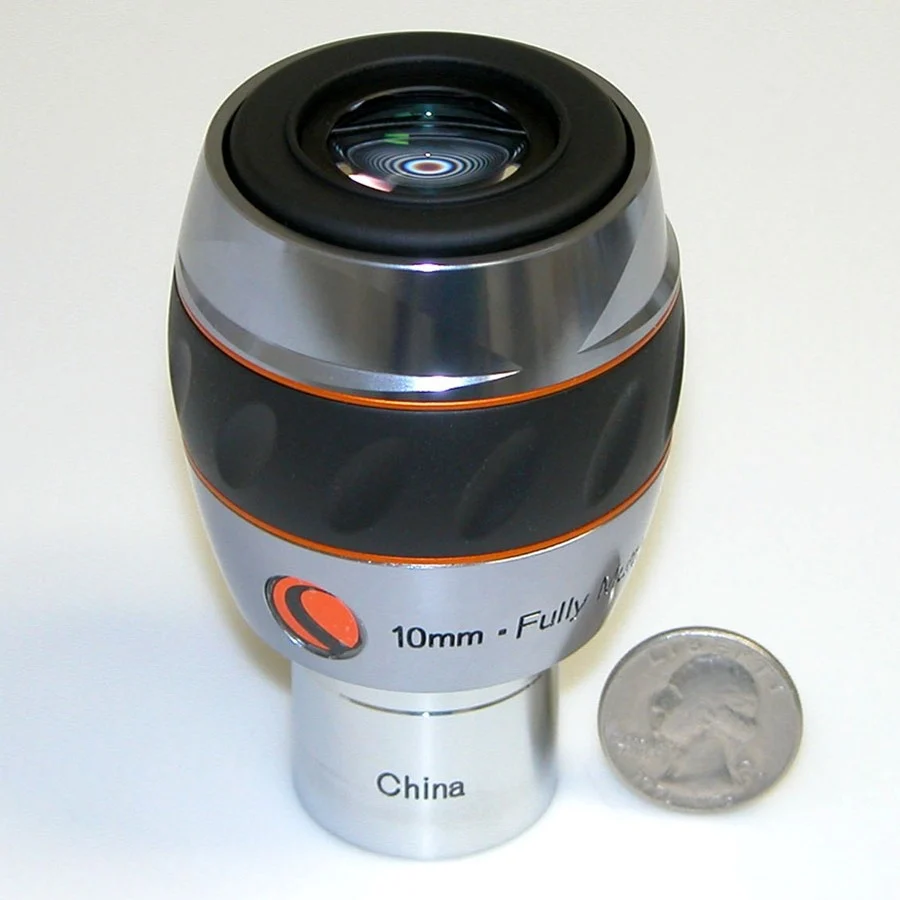
Celestron Luminos 19mm

A 19mm Celestron Luminos: a low-power eyepiece for framing large nebulae, galaxies and open clusters, from an affordable 82-degree ultra-wide that puts the big-field experience within reach.

81/ 100
Polaris Score
Optical quality · Immersion · Comfort · Value
See the breakdown ↓
What it's for
Low power · wide fieldHigh power · narrow field

Low power. At 19mm this is a low-power eyepiece for framing large nebulae, galaxies and open clusters; it is not the eyepiece for high-power planetary detail.

Apparent Field
82°
Barrel Size
2"
Eye Relief
15mm
Focal Length
19mm
From$199.95

Lowest in 90 days

Price tracked by PolarisObserved 55 timesTracking since Aug 2026

Try in simulator →
The spacewalk

You don’t look at a field.
You look into the sky.

Every number on the spec sheet matters less than one feeling: how much sky wraps around your eye. Widen the apparent field and watch the black edge of the eyepiece slip away.

82° apparent field

At 82°, the edge slips into your peripheral vision, you stop looking at a field and start looking into the sky.
Try this eyepiece on your own scope in the Simulator →
01What it's good at

What it's best at — and the trade-offs.

15mm of eye relief and a large eye lens make the wide field easy to take in.
Best at
✓15mm of eye relief and a large eye lens make the wide field easy to take in.
✓Solid machined build with a twist-up eyecup.
✓At 19mm it lands squarely in low power territory, exactly where wide star fields and large objects belong.
Trade-offs
!Edge astigmatism and some field curvature show up in fast scopes below f/6.
!Heavy, especially the 2-inch long focal lengths.
!A little internal reflection on bright objects like the Moon.
02In your telescope

One eyepiece. A different job in every scope.

25× in a small refractor, 107× in a long SCT

An eyepiece has no magnification of its own — the telescope decides. The same eyepiece becomes 25× and 3.3° of sky in a little refractor, or 107× and a tight frame in a long SCT. Here’s what it does across common scopes.

Small apo refractor
480 mm · f/5.5
Magnification
25×
True field
3.3°
Exit pupil
3.5 mm
25× across a 3.3° field at a 3.5mm exit pupil, right in the deep-sky sweet spot, bright and easy on the eye.
8-inch Dobsonian
1200 mm · f/6
Magnification
63×
True field
1.3°
Exit pupil
3.2 mm
63× across a 1.3° field at a 3.2mm exit pupil, right in the deep-sky sweet spot, bright and easy on the eye.
12-inch Dobsonian
1500 mm · f/5
Magnification
79×
True field
1.0°
Exit pupil
3.8 mm
79× across a 1.0° field at a 3.8mm exit pupil, right in the deep-sky sweet spot, bright and easy on the eye.
8-inch SCT
2032 mm · f/10
Magnification
107×
True field
46′
Exit pupil
1.9 mm
107× across a 46′ field at a 1.9mm exit pupil, crisp medium power for galaxies, clusters and planetary nebulae.
Exit pupil is how wide the beam of light leaving the eyepiece is. Around 5–6 mm is bright and immersive under dark skies; push much past 6 mm and you waste light, and under light pollution a smaller exit pupil shows more contrast.
03In plain English

The numbers, in plain English.

19mm FL · 82° AFOV · 2"
Focal lengthLow to mid power
19mm
Around 63x in an 8 inch f/5.9 Dobsonian and 107x in an 8 inch SCT. Low enough to locate and frame objects comfortably, high enough that the sky background stays dark under suburban skies.
Apparent fieldVery wide
82°
A wide apparent field at this focal length produces a true field large enough to hold most open clusters and the larger nebulae whole, which is where the extra glass earns its place.
Eye reliefComfortable
15mm
Relaxed viewing without glasses, and enough that you are not pressing your eye to the lens while scanning. Full-field viewing with spectacles is not practical.
BarrelRequires 2 inch focuser
2"
A 2 inch barrel is needed to pass the field stop for 82 degrees at 19 mm, so check that your telescope accepts 2 inch eyepieces. These are also physically heavy, which matters on a Dobsonian's balance.
OpticsWide-field value
Fully multi-coated
Full coatings hold the image bright through a large multi-element design. In fast telescopes the outer field shows aberration, which is the known trade for this much field at this price.
04What comes alive

The targets this eyepiece was born for.

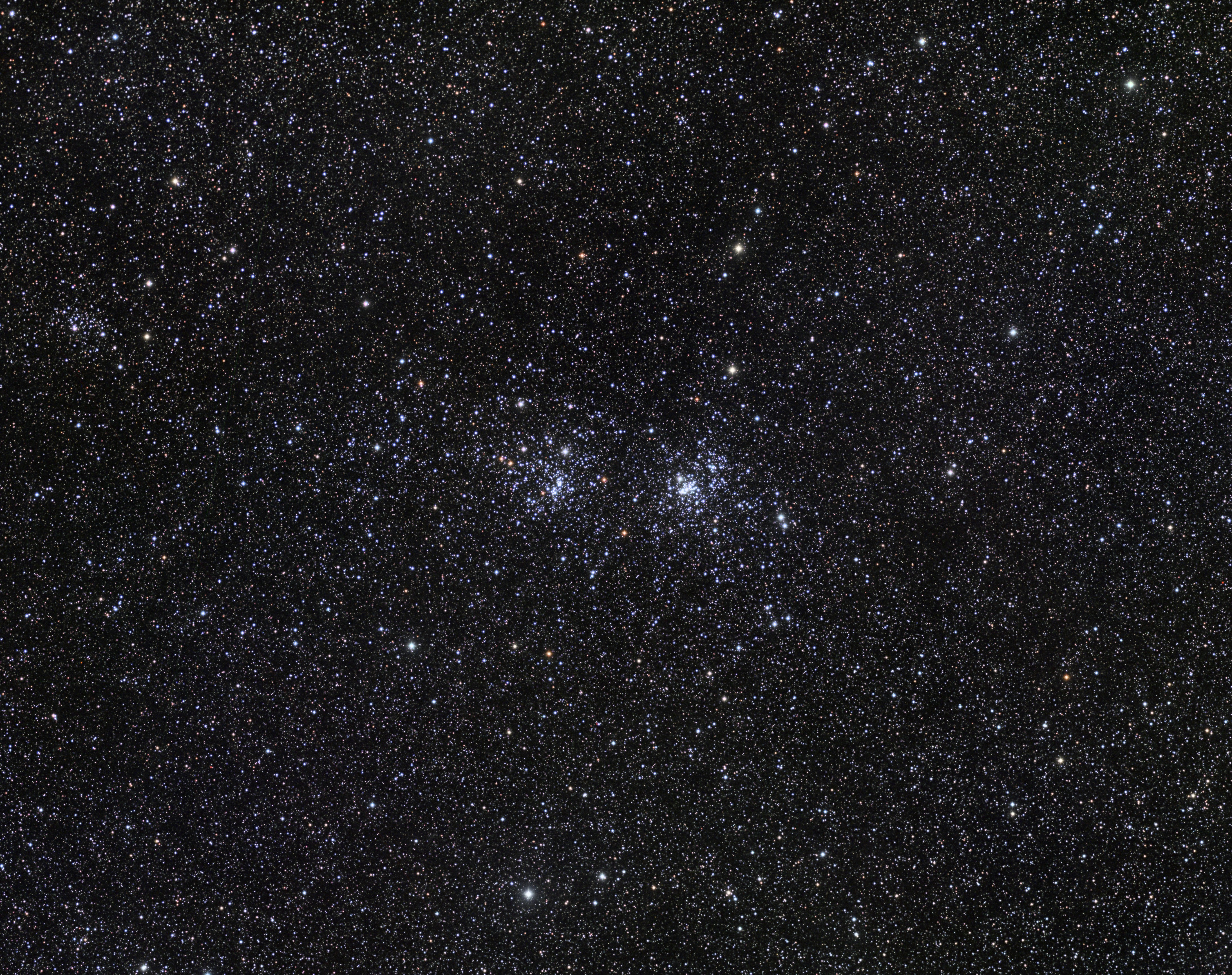
The Orion Nebula (M42), The Andromeda Galaxy (M31), The Pleiades (M45), The Double Cluster…
The Orion Nebula (M42)Comes alive
The Orion Nebula (M42)
Wings of nebulosity fill the field with the Trapezium embedded.
The Andromeda Galaxy (M31)Excellent
The Andromeda Galaxy (M31)
The bright core with its two companion galaxies framed.
The Pleiades (M45)Excellent
The Pleiades (M45)
The whole cluster with dark sky to spare around it.
The Double ClusterComes alive
The Double Cluster
Two open clusters glittering side by side in one view.
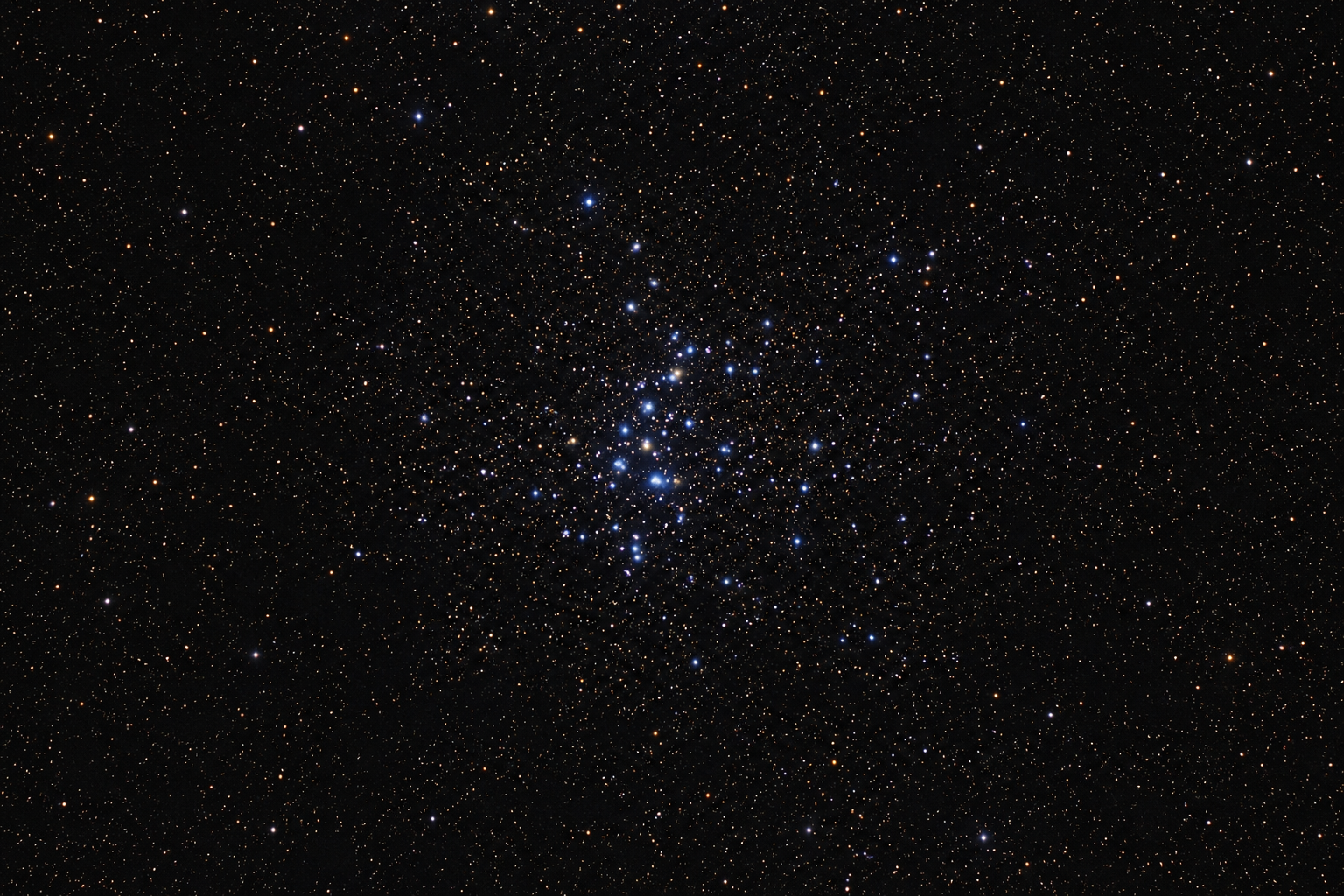
The Beehive (M44)Excellent
The Beehive (M44)
A loose scatter of bright stars, best at low power.
Large open clustersExcellent
Large open clusters
Bright, wide targets that want field, not magnification.
05Role in a collection

Where it sits in your eyepiece case.

Where it sits across 3 focal lengths

A good eyepiece collection isn’t a pile of glass — it’s two or three focal lengths that hand off from wide to tight. This is the anchor at the bottom of the ladder: the one you find and frame with. You buy it once, and it stays your low-power eyepiece for life.

32 mm
Low power · wide field
Find, frame and sweep. Your widest true field and the lowest useful magnification, the eyepiece you reach for first.
Veil Nebula · Pleiades · Milky Way star clouds
19 mmThis one
Medium power · the workhorse
Where most deep-sky objects look their best, galaxies, globulars and planetary nebulae at a comfortable scale.
M13 · Ring Nebula · most galaxies
7 mm
High power · detail
Planets, the Moon at the terminator, tight double stars and the smallest planetary nebulae. Steady-air nights only.
Jupiter · Saturn · lunar craters
06Build around it

What it pairs with.

The telescope · Pair it · Filter it
The telescope
What it goes into
Any 2-inch focuser
A 2-inch focuser or a 1.25-inch adapter; most Dobsonians and larger refractors qualify.
Fast, short scopes love this field
A fast Newtonian or refractor turns this focal length into a rich, wide sweep.
Pair it
What extends its range
A high-power eyepiece (~11mm)
Locate and frame with this one, then swap to high power for planets and small objects.
Filter it
What transforms the view
A UHC or OIII nebula filter
At low power this eyepiece frames big emission nebulae; a narrowband filter makes the Veil and North America jump out.
07The Polaris Score

How it scores, and why.

81/100
81/ 100
Celestron Luminos 19mm

Judged as a low-power eyepiece for framing large nebulae, galaxies and open clusters, it earns its score on a true 82-degree field for a fraction of the premium ultra-wides. The comfortable eye relief lifts it further. A wide field is what this focal length is for, and it delivers.

Optical quality
76
Immersion
93
Comfort
84
Value
78

Polaris weighs how well the eyepiece does the job it was designed for — optics, immersion, comfort and value — never list price or brand.

08Who it's for

An honest fit check.

Observers who want a low-power eyepiece for framing large nebulae, galaxies and open…
Buy it if you
✓Observers who want a low-power eyepiece for framing large nebulae, galaxies and open clusters.
✓Anyone who observes in eyeglasses; the eye relief here is long enough to see the whole field.
✓Deep-sky observers chasing the most immersive, wrap-around field they can get at this price.
Look elsewhere if you
!Anyone chasing the absolute widest field, who should look at a 100-degree eyepiece.
!Grab-and-go observers watching every gram, since this is not the lightest option.
!Planetary specialists who want the last ounce of high-power contrast from an orthoscopic.
09The numbers

Full specifications.

4 measured and stated values
Optical
Focal Length19mm
Apparent Field82°
Comfort & handling
Eye Relief15mm
Fit & build
Barrel Size2"
Editor’s Take

Sweep it across a rich star field and the reason to own this focal length is obvious in a second. That is what the Luminos is for.

— The Skynocular verdict