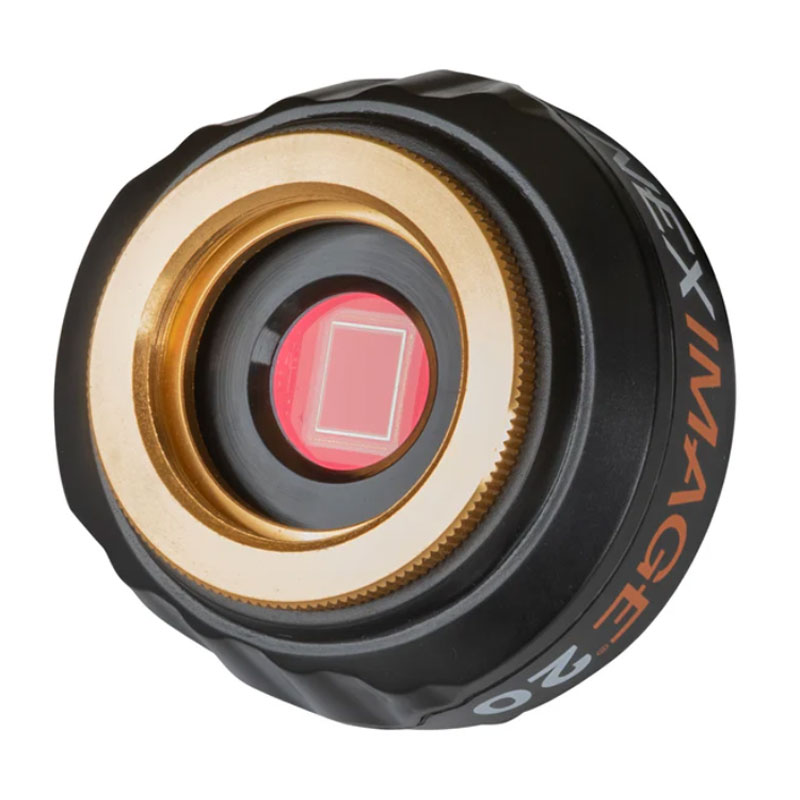
Celestron NexImage 20MP Solar System Color Imager — image 1
Celestron

Celestron NexImage 20MP Solar System Color Imager

A drop-in 20-megapixel planetary and lunar imager, thread it into a 1.25″ diagonal, run lucky imaging, and stack sharp Moon and planet detail without a laptop-grade astro-camera. Built for the solar system, not deep sky.

70/ 100
Polaris Score
Performance · ease · portability · upgrade path
See the breakdown ↓
Camera Type
Solar systemDeep sky

Squarely a planetary and lunar imager, high resolution on bright targets, not a deep-sky sensor.

Type
Planetary / lunar imager
Pixel Size
1.4µm
Resolution
5240 × 3840
Sensor Height
5.4mm
Sensor Width
7.3mm
From$449.95

Lowest in 90 daysLowest ever tracked

Price tracked by PolarisObserved 76 timesTracking since Jul 2026

Try in simulator →
Where to buy

Verified 13h ago · prices tracked daily

The frame it captures

Same camera. Different telescope. A completely different photograph.

A camera has no field of view of its own — the telescope in front of it decides everything. Pick a target and watch the same 20-megapixel frame become three different images.

RedCat 51
250 mm · f/4.9
FOV 1.7° × 1.2°
Overflows frame
Overflows the frame — the outer arms extend past the edges.
Esprit 100ED
550 mm · f/5.5
FOV 0.76° × 0.56°
Overflows frame
Only the bright core fits; the spiral arms spill off the sensor.
EdgeHD 8
2032 mm · f/10
FOV 0.21° × 0.15°
Overflows frame
Only the bright core fits; the spiral arms spill off the sensor.
Explore any telescope in the Simulator →
01What it's good at

What it's best at — and the trade-offs.

20 MP (5240 × 3840) resolves fine lunar and planetary detail, enough pixels for big Moon mosaics at long focal lengths.
Best at
✓20 MP (5240 × 3840) resolves fine lunar and planetary detail, enough pixels for big Moon mosaics at long focal lengths.
✓1.25″ nosepiece drops straight into a diagonal or focuser like an eyepiece, no adapters, no imaging train to design.
✓USB 3.0 keeps frame rates usable for lucky imaging: shoot thousands of frames, keep only the sharpest.
✓Plug-and-play with Celestron's capture software and the free stacking tools everyone uses (AutoStakkert, RegiStax).
Trade-offs
!1.4 µm pixels are low-sensitivity, strong signal only on bright targets (Moon, planets, filtered Sun).
!~8 fps at full resolution is slow for planets; you lean on a cropped region of interest for speed.
!Rolling shutter and no cooling rule out long-exposure deep-sky work.
!No guiding or filter control, it is a capture camera, nothing more.
02In plain English

The numbers, in plain English.

CMOS · 20MP · 1.4µm
Pixel sizeVery small
1.4 µm
Tiny pixels sample the image finely, which is exactly what planetary imaging wants: at long focal lengths you need many pixels across a small disc. The same small pixels collect little light each, which is why this sensor is unsuited to faint deep-sky work.
SensorPlanetary
20 MP colour CMOS, 7.3 × 5.4 mm
A one-shot colour sensor means no filter wheel and no channel alignment, so you point, record and process. The small sensor area is not a limitation here because planets occupy a tiny part of any frame.
Frame rateLucky imaging
8 fps full frame, faster cropped
Planetary imaging works by recording thousands of frames and keeping only the sharpest few percent, so frame rate is what sets image quality. Use a region of interest around the planet rather than the full sensor and the effective rate climbs sharply.
CoolingNot for deep sky
None
Thermal noise builds during long exposures, and without regulated cooling this camera is limited to the short exposures planetary and lunar work uses. Deep-sky imaging needs a cooled camera with larger pixels.
FittingDrop-in
1.25 inch nosepiece
It slides into any 1.25 inch focuser or diagonal in place of an eyepiece, so there is no adapter to source. Pair it with a Barlow to reach the focal ratio around f/15 to f/20 that planetary imaging prefers.
03The Polaris Score

How it scores, and why.

70/100
70/ 100
Celestron NexImage 20MP Solar System Color Imager
Performance
68
Ease of use
86
Portability
92
Upgrade potential
45

Polaris weighs how well the camera does the job it was designed for — image quality, sensitivity, versatility and value — never list price or brand.

04Who it's for

An honest fit check.

SCT and Maksutov owners who want to photograph the Moon and planets
Buy it if you
✓SCT and Maksutov owners who want to photograph the Moon and planets
✓Beginners taking a first step into solar-system imaging
✓Anyone who wants planetary capture without running a laptop rig
Look elsewhere if you
!Deep-sky imagers, tiny 1.4 µm pixels and no cooling make it poor on faint nebulae and galaxies
!Planetary specialists chasing the highest frame rates (a small-sensor ROI camera runs faster)
!Anyone who already owns a dedicated ZWO or QHY astro-camera
05The numbers

Full specifications.

12 measured and stated values
Sensor
TypeCMOS
Megapixels20
Pixel Size1.4µm
Connectivity & fit
InterfaceUSB 3.0
More
cooledNo
frame rate8 fps (full frame)
nosepiece1.25 inch
Sensor Height5.4mm
Sensor Width7.3mm
shutterRolling
Editor’s Take

Think of it as a photographic eyepiece: it turns an 8-inch SCT's long focal length into detailed Moon and planet stills using the same lucky-imaging-and-stack workflow the planetary crowd swears by. Just don't point it at a nebula.

— The Skynocular verdict