Apertura
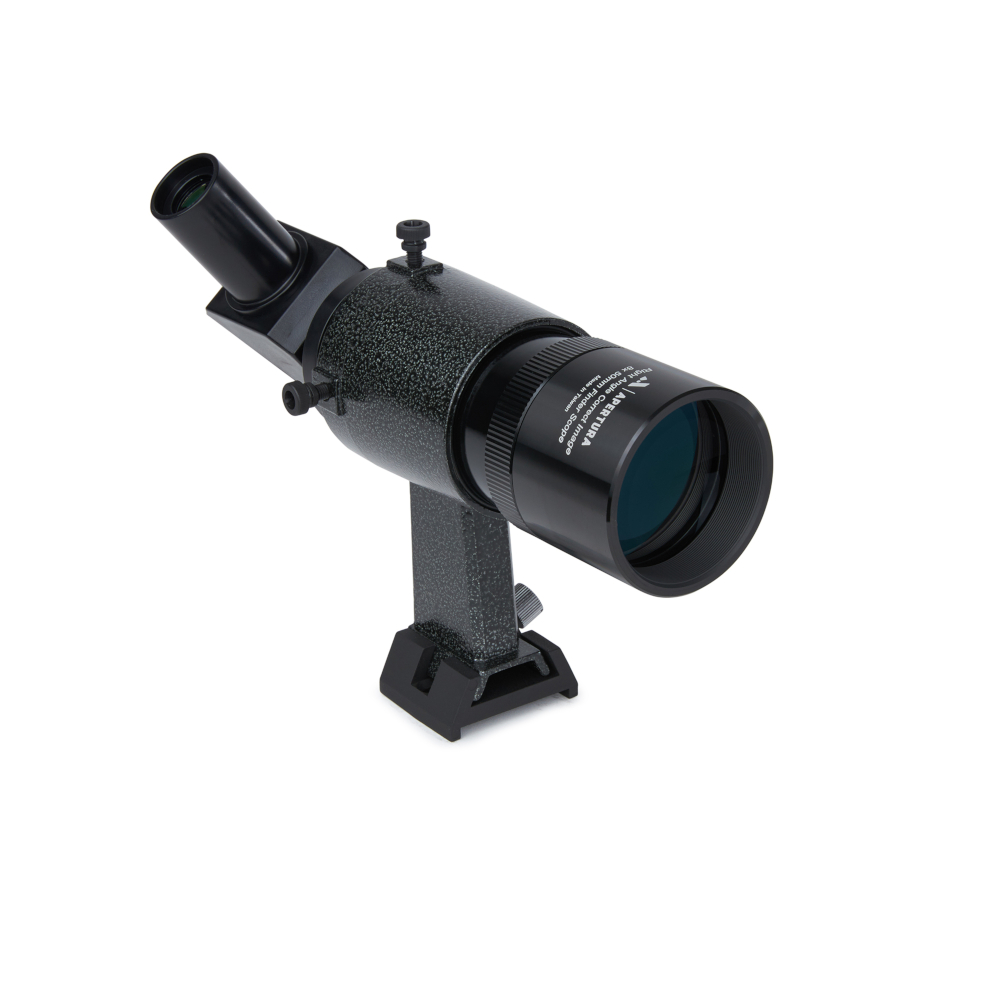
Apertura 8x50 Right Angle Finderscope and Bracket
8×50 · right angle, correct image
A magnified, correct-image finder that shows stars far too faint for a red-dot sight, and puts the eyepiece where your neck can actually reach it.
86/ 100
Polaris Score
#1 of 7 magnified finders under $100 we recommend
From$73.95
Where to buy
Affiliate link — we earn a commission, you pay the same. We rank on fit, not payout.
01Will it fit my setupCompatibility.
What this accessory works with — check the fit before you check the price.
01Will it fit my setup
Compatibility.
What this accessory works with — check the fit before you check the price.
What this accessory works with — check the fit before you check the price.
Most Newtonians and DobsoniansSCTs and MaksutovsRefractors with a finder shoeStandard dovetail finder bases
Note✕Needs a matching finder shoe on the tube✕Adds roughly 0.4 kg high on the tube✕Amici prism leaves a faint spike on bright stars✕Crosshair is not illuminated
02The numbersWhat These Numbers Mean
5 numbers in plain English · full specifications
02The numbers
What These Numbers Mean
5 numbers in plain English · full specifications
5 numbers in plain English · full specifications
Aperture
50 mm
This is the whole reason to prefer it over a reflex sight. Fifty millimetres collects around fifty times the light a dark-adapted pupil does, taking you from roughly sixth magnitude unaided to about ninth in the finder. In practice that is the difference between seeing the guide stars your chart names and seeing an empty field where they should be.
Magnification
8×
Eight power is the deliberate compromise. Enough to separate a guide star from its neighbours and to show a faint smudge where a Messier object sits, but low enough that the field stays wide and your hand movements do not throw the view around. Higher-power finders exist and are harder, not better, for finding.
True field of view
5.6°
Around eleven Moon-widths across, which is the span most star atlases are drawn to hop across. It is wide enough that you can find your starting star by eye, then walk to the target in two or three field-widths without ever losing your place, and narrow enough that what you see matches a chart rather than a whole constellation.
Image orientation
Correct image, via Amici prism
The Amici roof prism puts the view the right way up and the right way round, so what you see matches a printed chart or a phone app with no mental gymnastics. A plain right-angle finder without the roof prism gives a mirror image, which is the single most common reason a beginner hops the wrong direction. The trade-off is a faint diffraction spike on the brightest stars, which is harmless here.
Reticle
Crosshair, not illuminated
The honest limitation. Under a genuinely dark sky the black crosshair disappears against the background and you are guessing at the exact centre. It is a non-issue in the suburbs where there is enough skyglow to silhouette it, and an illuminated version costs roughly twice as much. Decide by where you actually observe.
Optics
Aperture50 mm, multi-coated
Magnification8×
True field of view5.6°
PrismAmici, correct image
ReticleCrosshair, non-illuminated
Mechanics
Viewing angle90° right angle
BracketIncluded, with base
AdjustmentSpring-loaded alignment screws
FocusThreaded eyepiece cell
03Before you buyGood to know.
The honest caveats — the things that save you a return, a bad first night, or a second purchase you didn't need.
03Before you buy
Good to know.
The honest caveats — the things that save you a return, a bad first night, or a second purchase you didn't need.
The honest caveats — the things that save you a return, a bad first night, or a second purchase you didn't need.
Align it in daylight, not at night.
Point the main telescope at a distant chimney or pylon, centre it in a high-power eyepiece, then walk the finder's screws until the crosshair sits on the same thing. Doing this on a star in the dark is slow and frustrating by comparison.
Check it still needs a shoe.
The bracket and base are included, but the base has to attach to something. Most Newtonians, Dobsonians and Maksutovs have a standard dovetail finder shoe already; some small refractors do not, and you will need to add one.
Right angle changes how you star-hop.
Looking down into a finder while the tube points up feels wrong for about one session. After that, hopping near the zenith stops involving the ground, and most people never go back to straight-through.
It does not replace a reflex sight, it complements one.
Many observers run both: the red dot to get roughly on target by eye, the 8x50 to do the actual hopping. They cost little together and each covers the other's weakness.
86/ 100
Apertura 8x50 Right Angle Finderscope and Bracket
8×50 · right angle, correct image · $73.95
A magnified, correct-image finder that shows stars far too faint for a red-dot sight, and puts the eyepiece where your neck can actually reach it.