Tele Vue
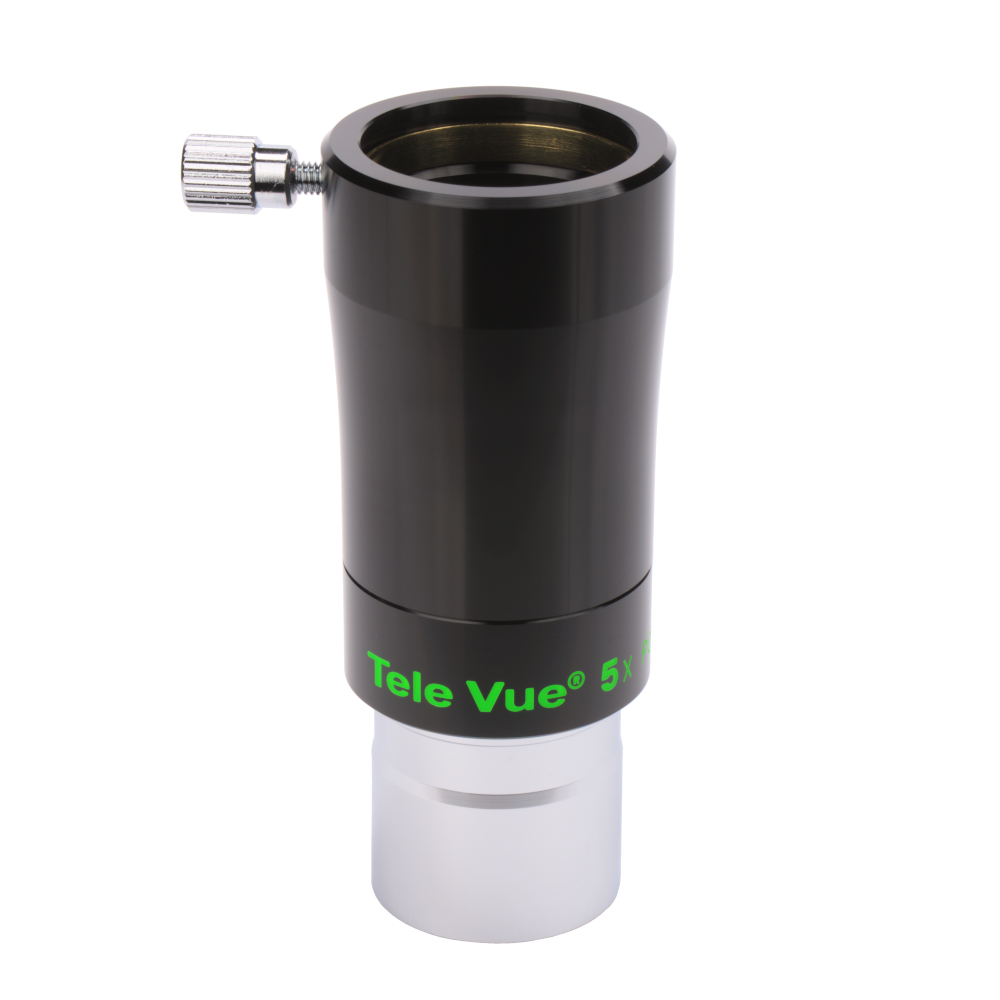
Tele Vue 5.0x - 1.25" Powermate
1.25″ · 5× telecentric
A 5x amplifier whose magnification does not drift when you change spacing, which is what makes it the right tool for hitting a specific focal ratio on a fast Newtonian.
90/ 100
Polaris Score
#1 of 5 high-power amplifiers we recommend
From$260
Where to buy
Affiliate link — we earn a commission, you pay the same. We rank on fit, not payout.
01Will it fit my setupCompatibility.
What this accessory works with — check the fit before you check the price.
01Will it fit my setup
Compatibility.
What this accessory works with — check the fit before you check the price.
What this accessory works with — check the fit before you check the price.
Planetary camerasFast NewtoniansVisual high powerAhead of an ADCT-ring adapter for cameras
Note✕5× is too much for most SCTs✕Dims the view considerably for visual use✕Needs steady seeing to be worth it✕T-ring adapter sold separately
02The numbersWhat These Numbers Mean
5 numbers in plain English · full specifications
02The numbers
What These Numbers Mean
5 numbers in plain English · full specifications
5 numbers in plain English · full specifications
Telecentric design
Parallel output beam
This is the specification you are paying for. A conventional Barlow diverges its output, so magnification climbs as the camera moves further back and a nominal 2x can behave like 2.7x. A Powermate re-collimates the beam, so 5x is 5x with any spacing, filter, or filter wheel in between. When your target focal ratio comes from a calculation, an amplifier that changes value with spacing turns the calculation into guesswork.
Amplification
5×
Five times is a large jump and it suits exactly one common situation: a fast Newtonian, f/4 to f/5, that needs to reach f/20 or so. Put it on an f/10 SCT and you arrive at f/50, which is four times more magnification than the atmosphere will usually support and a planet so dim your frame rate collapses. Match the amplifier to the telescope, not to ambition.
Barrel size
1.25″
The right size for this job. Planetary cameras have small sensors and 1.25-inch nosepieces, so there is nothing to gain from a 2-inch barrel and a good deal of weight and cost to lose. The 1.25-inch Powermates also accept a dedicated T-ring adapter that threads the camera on directly, which is more rigid than clamping a nosepiece.
Element count
4 elements, 2 groups
Two doublets rather than the single negative lens in a cheap Barlow. That is what allows the telecentric output while keeping the field flat and colour-free at high amplification. At 5x, a simple Barlow would show its own chromatic aberration on a bright limb, which would sit on top of whatever the atmosphere is already doing.
Camera attachment
T-ring adapter, sold separately
The honest catch. Getting a camera solidly onto this needs the matching Tele Vue T-ring adapter, which is an extra purchase on top of an already expensive accessory. You can push a 1.25-inch nosepiece into it instead, but a threaded connection holds alignment better at long focal length, where any tilt shows up immediately.
Optical
Amplification5× fixed
DesignTelecentric, 4 elements
Barrel1.25″
Magnification driftNone, by design
Practical
Camera attachmentVia Tele Vue T-ring adapter (PTR-1250)
WarrantyLife of product line plus 5 years
CountryDesigned in the USA
03Before you buyGood to know.
The honest caveats — the things that save you a return, a bad first night, or a second purchase you didn't need.
03Before you buy
Good to know.
The honest caveats — the things that save you a return, a bad first night, or a second purchase you didn't need.
The honest caveats — the things that save you a return, a bad first night, or a second purchase you didn't need.
Work out your target focal ratio first.
Multiply your camera's pixel size in microns by five for good seeing, three for fair, seven for excellent. Divide that by your telescope's native focal ratio and you have the amplification you need. Buy to that number rather than to the biggest one available.
5× is a Newtonian tool.
On an f/4 or f/5 Newtonian it lands you almost exactly where a 3.75 micron camera wants to be. On an f/10 SCT it overshoots badly. If you own an SCT, the 2.5x is usually the correct member of this family.
It goes in front of the ADC.
The usual order is filter, then amplifier, then dispersion corrector, then camera, so the ADC sits in the slow beam the Powermate creates. That is where prisms behave best.
Expensive, and it does not expire.
The price is hard to justify against a $60 Barlow on paper. The argument for it is that it will outlast several cameras and telescopes without ever being the limiting element, and Tele Vue's warranty runs for the life of the product line plus five years.
90/ 100
Tele Vue 5.0x - 1.25" Powermate
1.25″ · 5× telecentric · $260
A 5x amplifier whose magnification does not drift when you change spacing, which is what makes it the right tool for hitting a specific focal ratio on a fast Newtonian.