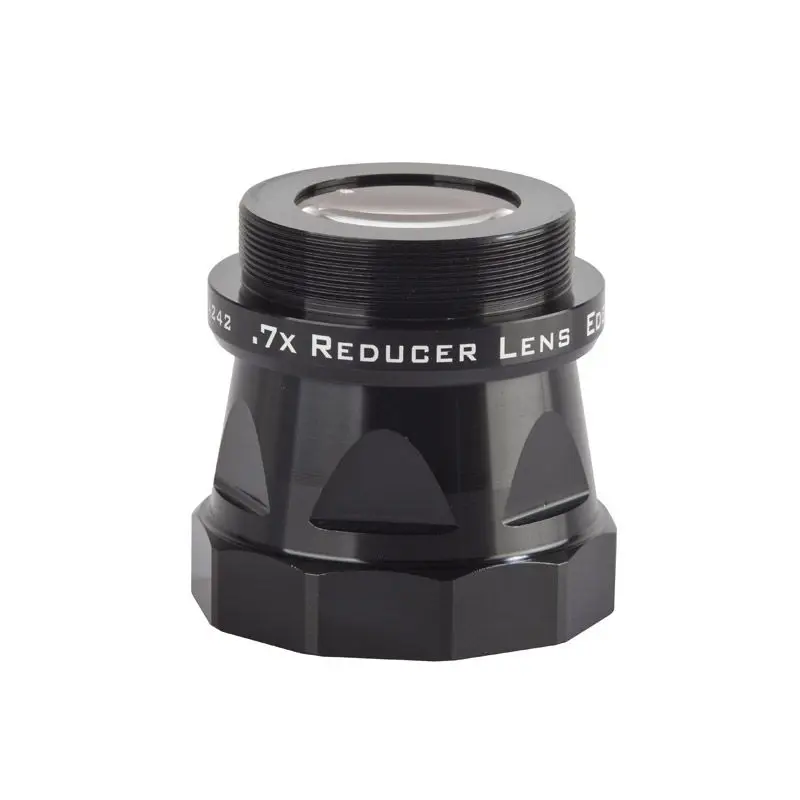
Celestron 0.7x Focal Reducer for EdgeHD — image 1
Celestron

Celestron 0.7x Focal Reducer for EdgeHD

This is the single accessory that converts an EdgeHD from a planetary telescope into a deep-sky imaging telescope, halving exposure times while holding stars round to the corners of an APS-C sensor. It is also aperture-specific, expensive, and pointless for visual use — buy it only if you image.

86/ 100
Polaris Score
From$439
Where to buy
Affiliate link — we earn a commission, you pay the same. We rank on fit, not payout.
02The numbers

What These Numbers Mean

6 numbers in plain English

6 numbers in plain English

Reduction factor
0.7x
An EdgeHD 8's 2032 mm becomes about 1422 mm; the EdgeHD 11's 2800 mm becomes roughly 1960 mm. That is a meaningfully wider field, enough to fit targets that spilled off the sensor before, while still being long enough that small galaxies and planetary nebulae stay well sampled.
Resulting focal ratio
f/7 (from f/10)
Doubling the light per pixel per unit time is the whole point. A three-minute sub becomes as deep as a six-minute one, which means shorter guided exposures, fewer frames lost to wind or a bad guide correction, and usable data on nights that would otherwise be a write-off.
Corrected image circle
APS-C class
Stars stay round across a typical cooled APS-C or four-thirds sensor, which covers the great majority of dedicated astro cameras. Push to full frame and the extreme corners soften, not catastrophically, but enough that you will crop or accept it.
Back focus
Fixed, spec-critical
The reducer only delivers its flat field at one specific camera-to-reducer distance. Most first-light disappointment with this accessory is a spacing error rather than a bad copy. Measure your filter wheel, adapters, and camera sensor depth before you blame the optics.
Compatibility
EdgeHD only, matched per aperture
This is computed against the EdgeHD's built-in field-flattening corrector, so it is not a generic SCT reducer and the 8", 9.25", and 11" units are genuinely different optics. Confirm your telescope's aperture before ordering, because the boxes look nearly identical.
Weight
~1.1 kg
It hangs at the very back of the tube, the worst place for leverage, and it arrives on top of a camera, filter wheel, and off-axis guider. Expect to rebalance in both axes, and treat it as real payload budget on a mount that was already near its comfortable limit.
Editor’s Take

Most EdgeHD owners buy the telescope for its flat field and then spend a year quietly wondering why deep-sky imaging feels so slow. This is the part that answers that question. Nothing about it is exciting to look at — a short barrel of glass, a few hundred dollars, ten minutes of spacer math — and then the same target that took a whole night suddenly takes half of one.

— The Skynocular verdict
86/ 100
Celestron 0.7x Focal Reducer for EdgeHD
$439

This is the single accessory that converts an EdgeHD from a planetary telescope into a deep-sky imaging telescope, halving exposure times while holding stars round to the corners of an APS-C sensor. It is also aperture-specific, expensive, and pointless for visual use — buy it only if you image.