ZWO
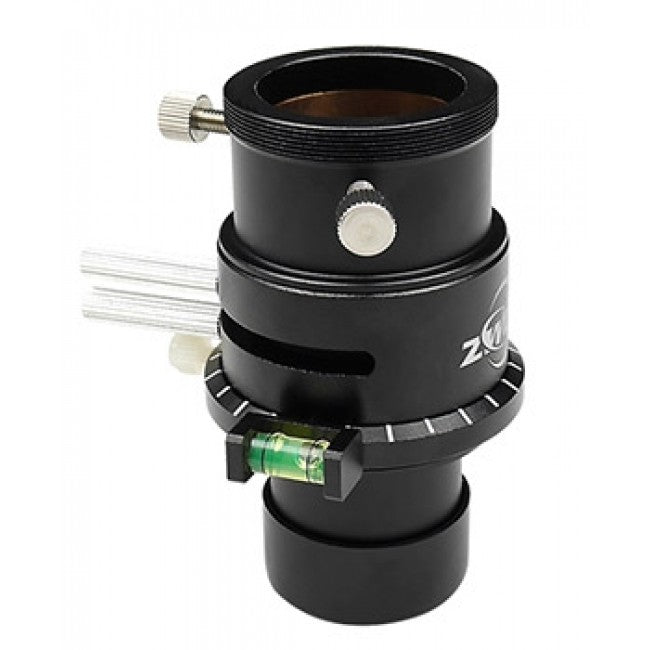
ZWO ADC Atmospheric Dispersion Corrector
1.25″ · twin rotating prisms
Cancels the red and blue fringes the atmosphere smears across a low planet, which is the single biggest gain available to anyone imaging Jupiter or Saturn from below about 40 degrees elevation.
84/ 100
Polaris Score
#1 of 3 atmospheric dispersion correctors we recommend
From$149
Where to buy
Affiliate link — we earn a commission, you pay the same. We rank on fit, not payout.
01Will it fit my setupCompatibility.
What this accessory works with — check the fit before you check the price.
01Will it fit my setup
Compatibility.
What this accessory works with — check the fit before you check the price.
What this accessory works with — check the fit before you check the price.
Planetary camerasVisual eyepiecesSCTs and MaksutovsBehind or ahead of a BarlowMono and one-shot colour
Note✕Adds 30 mm of back focus✕Wants f/15 or slower to work well✕No use on deep-sky or wide-field✕Needs re-tuning as the planet moves
02The numbersWhat These Numbers Mean
5 numbers in plain English · full specifications
02The numbers
What These Numbers Mean
5 numbers in plain English · full specifications
5 numbers in plain English · full specifications
Back focus added
30 mm
This is the number that decides whether the ADC fits your telescope at all. Inserting it pushes focus 30 mm further out, which a Schmidt-Cassegrain absorbs without noticing because its focuser moves the mirror across a huge range. A Newtonian often cannot: many reach focus with a camera only barely, and 30 mm more is 30 mm they do not have. Check you can still reach focus before you buy.
Deviation angle
2° per prism
Each wedge bends light by two degrees, and rotating the pair relative to each other sets how much of that bend survives as net dispersion. Fully crossed gives you zero correction, fully aligned gives the maximum. That range comfortably covers a planet from about 20 degrees elevation upward, which is the span where correction actually matters.
Working focal ratio
f/15 and slower
Prisms in a steeply converging beam introduce their own aberrations, so an ADC wants a slow, near-parallel light cone. That is not a restriction in practice: planetary imaging already runs at f/15 to f/25 because of the 5x rule, so the Barlow you are using for image scale is also what makes the ADC behave. Placing it after the Barlow, in the slower beam, is the usual arrangement.
Bubble level
Built in
Atmospheric dispersion is always vertical, so the correction has to be vertical too. The levelling bubble tells you the prism axis is square to the horizon, and getting this wrong is the most common reason people conclude an ADC "does nothing". Set it level first, then tune the levers.
Prism glass
H-K9L, λ/10, AR coated
H-K9L is the Chinese equivalent of Schott BK7, figured to a tenth of a wave and anti-reflection coated above 98 percent transmission. At planetary brightness the light loss is irrelevant, but the surface figure is not: two extra glass surfaces in the path of a 300-pixel-wide Jupiter would show immediately if they were poorly made.
Optics
PrismsTwo counter-rotating, H-K9L
Deviation angle2° each
Surface accuracyλ/10 @ 632.8 nm
CoatingAR, >98% transmission
Mechanics
Back focus added30 mm
ThreadsFemale T2 both ends
Adapters included1.25″ nosepiece + 1.25″ eyepiece holder
HolderBrass compression ring
LevellingBuilt-in bubble level
03Before you buyGood to know.
The honest caveats — the things that save you a return, a bad first night, or a second purchase you didn't need.
03Before you buy
Good to know.
The honest caveats — the things that save you a return, a bad first night, or a second purchase you didn't need.
The honest caveats — the things that save you a return, a bad first night, or a second purchase you didn't need.
Tune it on the screen, not by theory.
Zoom the live preview, watch the limb of the planet, and move the levers apart until the blue rim and the red rim both disappear. FireCapture's edge-enhance display makes the moment obvious. There is no setting to calculate and no table to look up.
It needs retuning through the night.
The correction depends on elevation, so a planet climbing or sinking changes what the prisms should be doing. Check it every twenty minutes or so, and expect to move the levers closer together as the target rises.
Level matters more than people expect.
The prism axis must be perpendicular to the horizon or you are correcting along the wrong direction and adding a sideways smear. Use the bubble, and re-check it if you rotate the camera.
Almost useless above 60 degrees.
Dispersion falls away fast with elevation. If your planets ride high, the honest answer is that this accessory will spend most of its life doing very little, and your money is better spent elsewhere.
84/ 100
ZWO ADC Atmospheric Dispersion Corrector
1.25″ · twin rotating prisms · $149
Cancels the red and blue fringes the atmosphere smears across a low planet, which is the single biggest gain available to anyone imaging Jupiter or Saturn from below about 40 degrees elevation.