Agena
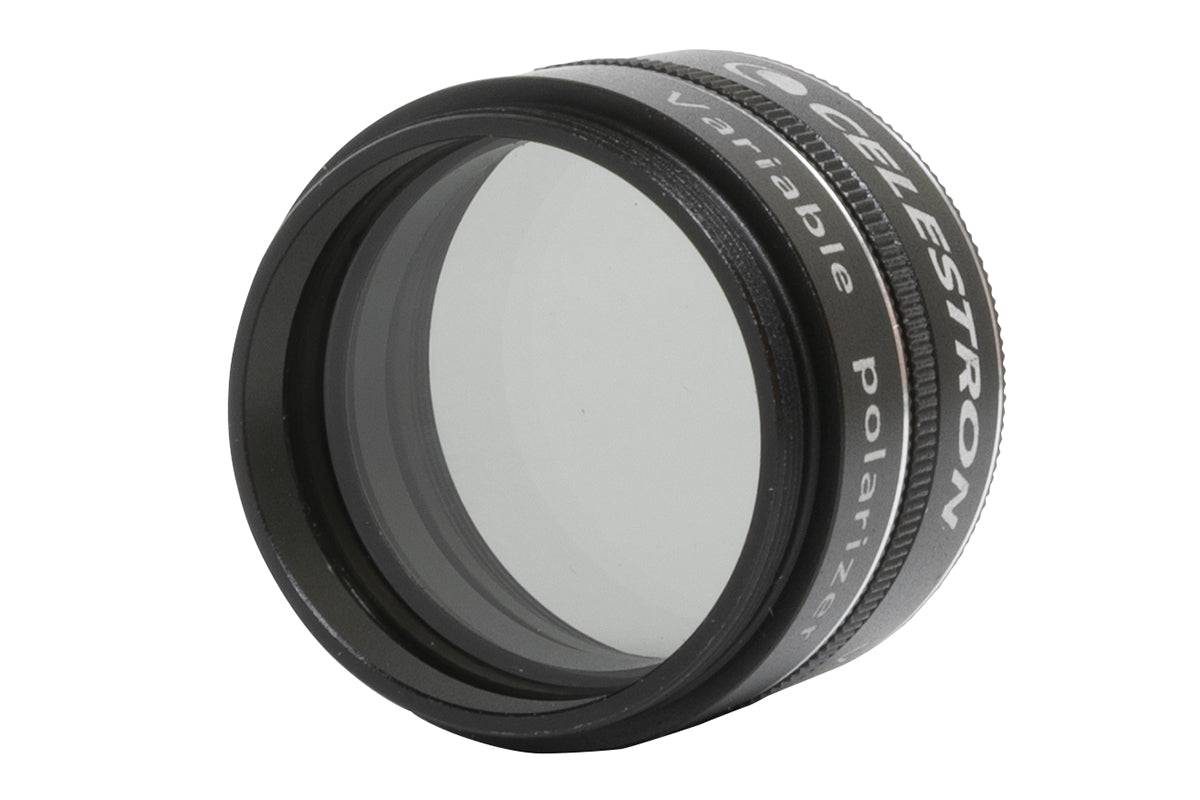
Variable Polarizing Moon Filter 1.25-inch
Two polarizers you turn against each other, so you set the Moon's brightness for the phase and the telescope instead of living with one fixed strength. The most flexible way to tame the Moon, at the cost of a second piece of glass in the light path.
80/ 100
Polaris Score
The adjustable moon filter
02Be honest with meWhat this filter does NOT do.
It only makes things dimmer. That is exactly right for the Moon and wrong for nearly everything else in the sky.
02Be honest with me
What this filter does NOT do.
It only makes things dimmer. That is exactly right for the Moon and wrong for nearly everything else in the sky.
It only makes things dimmer. That is exactly right for the Moon and wrong for nearly everything else in the sky.
✕Nebulae and galaxies
Faint objects need every bit of light the telescope gathers. Even wide open, two polarizers cut more than half of it, so a faint galaxy simply gets fainter. Take it out when you leave the Moon.
✕Detail the telescope cannot show
It does not add resolution, and it does not steady a shimmering atmosphere. A soft view made dimmer is still soft.
✕Demanding high-power planetary work
Two glass elements are more than one. On a night of excellent seeing a single fixed neutral filter, or none, is marginally cleaner.
✕The Sun. Never.
A moon filter is nowhere near dark enough for sunlight, and at the eyepiece end it sits in the focused beam, where it can crack. Solar viewing needs a certified solar filter over the FRONT of the telescope.
03Where it fitsWhere it lives in your kit.
A filter isn't a standalone instrument — it threads into the light path just before your eye. Here's the chain.
03Where it fits
Where it lives in your kit.
A filter isn't a standalone instrument — it threads into the light path just before your eye. Here's the chain.
A filter isn't a standalone instrument — it threads into the light path just before your eye. Here's the chain.
→
→
→
→
04Which filterHow the moon filter options compare.
They all do one thing: cut brightness. The difference is how much, and whether you can change it at the eyepiece.
04Which filter
How the moon filter options compare.
They all do one thing: cut brightness. The difference is how much, and whether you can change it at the eyepiece.
They all do one thing: cut brightness. The difference is how much, and whether you can change it at the eyepiece.
No filter
Baseline
Transmission
100%
Best for
Small scopes, thin crescents
Below about 4 inches, or near new Moon, you often do not need one at all.
ND 25%
Light neutral
Transmission
~25%
Best for
4 to 6 inch scopes
Takes the edge off without making the view dim.
ND 13%
Neutral density
Transmission
~13%
Best for
Bright phases, 6 inch and up
The common fixed choice: one strength, nothing to adjust.
This one
Variable polarizing
Adjustable
Transmission
~1–40%
Best for
Every phase and aperture
Two polarizers you turn against each other to set the brightness.
Coloured moon filter
Tinted
Transmission
Varies
Best for
Rarely the best pick
Dims the Moon but tints it green or blue. A neutral filter keeps its natural colour.
05The numbersWhat These Numbers Mean
5 numbers in plain English · full specifications
05The numbers
What These Numbers Mean
5 numbers in plain English · full specifications
5 numbers in plain English · full specifications
TransmissionVariable
Adjustable, roughly 1 to 40 percent
Two polarising elements rotate against each other, so you dial in exactly as much dimming as the phase and your aperture need. A thin crescent and a full Moon want very different amounts of light held back.
What changesComfort
Glare, not resolution
It will not show you more detail than the telescope can resolve. It stops the glare that makes your eye close down, which is what lets subtle contrast in the maria and along the terminator become visible.
Also useful onPlanetary
Venus and Jupiter
Venus is bright enough to be uncomfortable in any decent telescope, and taking the edge off makes phase detail easier to see. It helps on Jupiter in larger apertures for the same reason.
Barrel sizeStandard
1.25 inch
Threads onto the standard eyepiece barrel, so it works on essentially any telescope. Note that adjusting it means rotating the eyepiece or the filter, which takes a moment at the eyepiece.
Trade-offOptical
Two glass elements
More glass in the light path than a single neutral density filter, so on very demanding high-power planetary work a fixed neutral filter is marginally cleaner. For lunar use the flexibility is worth more.
Optical
TypeVariable polarizing, two elements
TransmissionAdjustable, roughly 1–40%
ColourNeutral grey
UseVisual: the Moon, Venus, and Jupiter in large scopes
Fit
Cell size1.25″
Adjust byTurning one element against the other
06Pairs withCompatible gear.
2 matches for this filter
06Pairs with
Compatible gear.
2 matches for this filter
2 matches for this filter
Telescopes
Works across apertures
4 to 6 inch
Set it light for gibbous phases
8 inch and larger
Set it dark near full Moon
Eyepieces
Fits any 1.25″
Low power, whole disc
Brightest view, most benefit
Medium power, terminator
Dial it back for long sessions
07Learn moreGuides worth reading next.
2 guides that cover this ground
07Learn more
Guides worth reading next.
2 guides that cover this ground
2 guides that cover this ground
Guide
Why Do People Put Filters on Telescopes?
How removing light helps you see more: the nebula filters that boost contrast, the moon filters that tame glare, and the solar filters that make the Sun safe.
Read the guide →
Guide
Why Does Aperture Matter More Than Magnification?
The same aperture that shows faint galaxies is what makes the Moon uncomfortably bright. Why bigger telescopes need a moon filter more than small ones.
Read the guide →